- calendar_today August 17, 2025
From Cosmic Storms to Parenthood: A Family-Centered Marvel Tale
Marvel’s The Fantastic Four: First Steps is a visually stunning, deeply old-school take on one of the publisher’s first superhero teams. (A few “Oh, God, is it one of those movies” jokes about the late, lamented Fantastic Four movies are also called for.) Chock-full of capable performances (Pedro Pascal and Ebon Moss-Bachrach are particularly good), First Steps indulges its Saturday-morning-cartoon vibe with zest and verve. For all its retro pep, however, this reboot lacks the visceral kick to make it stick.
Producer Kevin Feige was right when he said the new movie is “a no-homework-required” movie. After decades in which Marvel movies have woven an increasingly dense tapestry of multiverses, multiverse cameos, spin-offs, and recastings, it’s a relief to have a Marvel movie that requires no familiarity with prior events or history. This is, by design, a reimagining of Reed Richards, Sue Storm, Johnny Storm, and Ben Grimm, starting from scratch and with no allegiance to any of the continuity of past film or TV adaptations of the team. The movie is even on-screen content to be kind of dumb, and, at times, too much so.
Early in the movie, a talk show with host Mark Gatiss recaps how four of the world’s leading scientific minds first became the Fantastic Four: a space mission that went awry four years ago when the subjects were exposed to high radiation that affected their DNA. Reed (Pedro Pascal) can stretch his body like a rubber band. Sue (Vanessa Kirby) can turn herself invisible and project force fields. Johnny (Joseph Quinn) can ignite himself like a human torch and fly. And Ben (Ebon Moss-Bachrach) was transformed into The Thing, a rock-skinned giant with super strength.
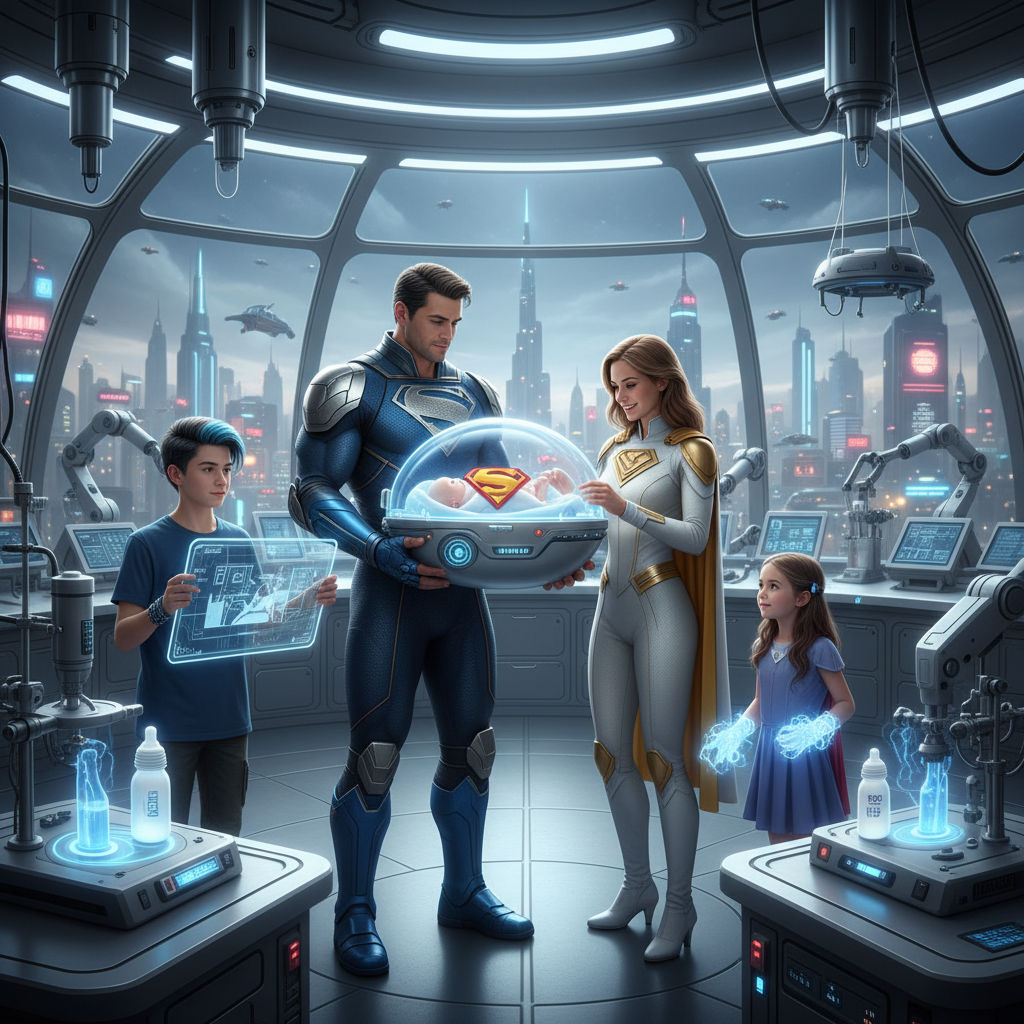
The setup is charming, but the plot sags under its lack of urgency. The theme of the movie is family, in the microcosm of the tight-knit four leads. Sue gets word that she’s pregnant early on in the movie, and Reed’s anxiety about it is both relatable and precious. He has H.E.R.B.I.E. run through a checklist of baby-proofing in both the house and the science lab. Johnny and Ben play like an older brother and younger brother, bickering and cracking wise, but looking forward to the addition of a new family member.
But the moment is interrupted by the ancient cosmic presence that makes an appearance in several Marvel Comics universes. Galactus, a huge suit of armor with glowing eyes, is heading for Earth to eat the planet. Before he gets there, he sends an emissary, a herald wearing a skin-tight silver suit and named, confusingly, The Silver Surfer. (Julia Garner plays her in motion capture.) Her arrival is sleek and foreboding; she soon becomes the object of curiosity (and lust) for Johnny. Galactus turns out to be more goofy than menacing, a massive rolling silver sphere with a giant amoebic hand that punches through walls.
That’s still not enough to up the ante on the action, though. While the heroes chase Galactus through space and dodge the attacks of the Silver Surfer, the CGI effects are dialed back to look more like light beams, fire from the Human Torch, and cartoonish stylization than overwhelming. Sue goes into labor during the climactic battle and has to be rushed back to Earth while the heroes are in space, and there is an unstated but understood ticking clock on how long she can hold out. (Midway through, it’s not even clear why the planet’s destruction can’t be delayed.) The whole thing is more trippy than tense.
It’s also an odd combination: cosmic threat and family-values tale. Sue is both birthing a new life and, it’s implied, ending the life that she and her husband had intended. The baby she’s having in this future sequence is also clearly part of the status quo that the film works so hard to establish. The finale manages to be both otherworldly and weirdly bucolic at the same time: an inflatable glowing orange moon in pastel shades of blue and lavender skies, interstellar fireworks, and churning silver amoeba and car-sized fungus bursting like a teenager’s blister. It’s almost psychedelic, but the film never matches the stakes with the visuals.
That disjunction of sincere emotional moments and hushed volume says a lot about the tone of the whole film. This is earnest without seeming squishy, which is a testament to the actors, the art direction, and the screenplay. But it never finds the oomph of the Marvel movies that it most resembles. Is it a caper like Guardians of the Galaxy? Not really. Is it an ensemble family melodrama à la the 2019 Captain Marvel? Maybe. Is it a weighty tale of cosmic apocalypse in the vein of Thor: Ragnarok? You’ll never guess!
In the end, The Fantastic Four: First Steps is delightful to look at, full of capable performances, and respectful and reverent in its treatment of a Marvel Comics property. It’s as low-stakes as a Marvel superhero movie has any business being without feeling completely inconsequential, and it’s the rare family adventure that can easily be shared by kids and adults with equal interest. It’s also lighter than air, both in theme and in the drama department. If you want something lighter than, say, The Marvels, it’s a better way to spend two hours than some other options. But it’s also not much of an explosion.