- calendar_today August 7, 2025
.
Ukrainian President Volodymyr Zelenskyy told reporters on Monday that he had a “good” conversation with U.S. President Donald Trump on the issue of security guarantees for Ukraine as the war with Russia heads into its fourth year.
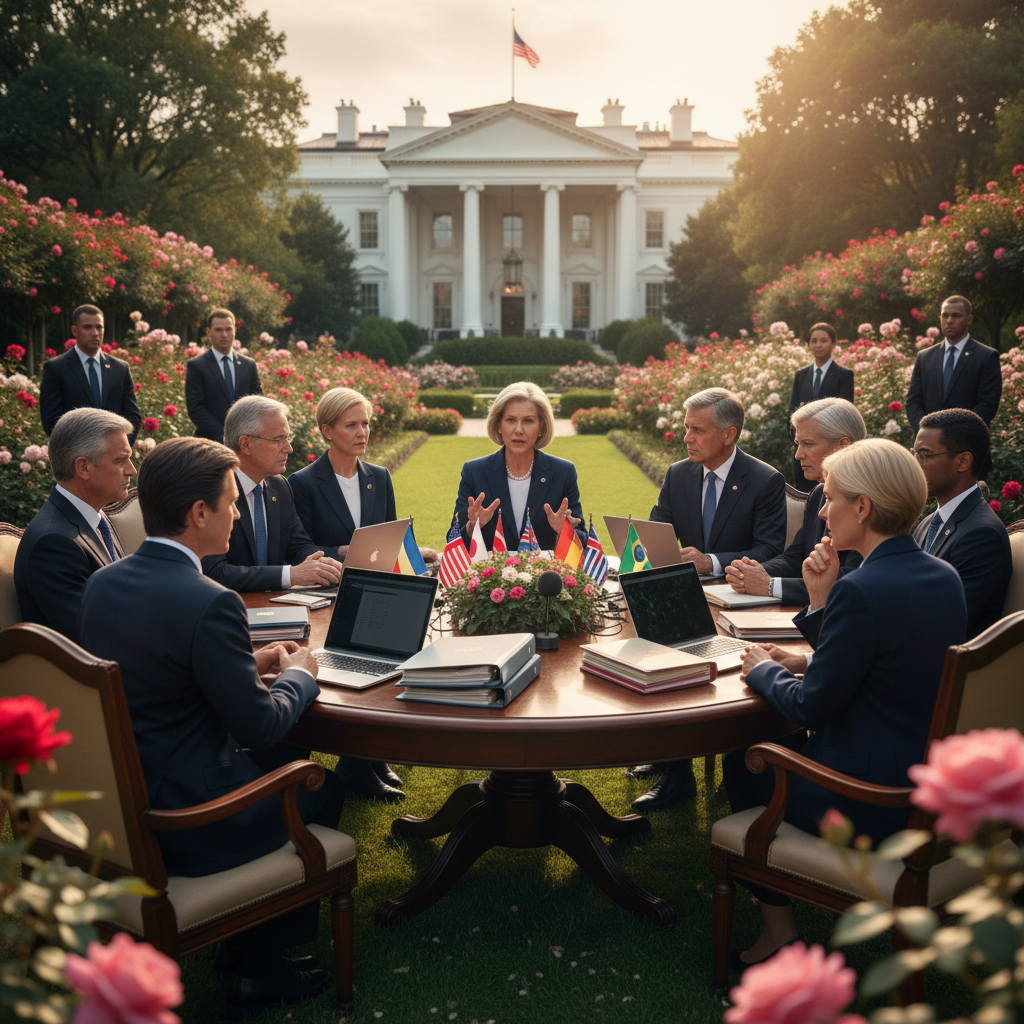
“We have this ongoing fight for survival, for our future, for our independence,” Zelenskyy said in the White House Rose Garden alongside Trump and European leaders. “The first one is security guarantees. And we are very happy with President [Trump], that all the leaders are here, and security in Ukraine depends on the United States and European countries.”
Zelenskyy said Washington’s readiness to give strong signals of support to Ukraine is “very important,” without elaborating on the specifics of any potential guarantees.
Trump said security was of utmost importance, but that Europe had to pay the most. Like Zelenskyy, he said a ceasefire was not a prerequisite for negotiations. The president also said the conflict could not be solved without “tough” talks on territory. “We’re going to help them, and we’re going to make it very secure,” Trump said. “We also need to discuss the possible exchanges of territory, taking into consideration the current line of contact. That means the war zone, the war line center.”
The White House meeting between Zelenskyy, Trump, and European leaders brought into sharp relief disagreements in Washington and Europe over how to balance support for Ukraine with a desire for a negotiated peace. Trump, in particular, has proved more open to the idea of concessions to Moscow than Zelenskyy, who has steadfastly refused to contemplate surrendering any territory or compromising Ukraine’s sovereignty and international borders.
Senators in Washington also debated sanctions and a ceasefire
As the leaders in Washington debated the issue of security guarantees, U.S. senators were sharpening calls to ratchet up economic pressure on Russia and countries that continue to do business with Moscow. Senator Lindsey Graham, R-S.C., said the Trump administration should “rob Peter to pay Paul” and attack the Kremlin’s finances by sanctioning nations still buying Russian oil.
Graham is co-sponsoring a bill that would empower Trump to levy tariffs of up to 500 percent on countries continuing to trade with Russia.
“My advice to President Trump and [Secretary of State Marco Rubio] is, you’ve got to convince Putin that if this war doesn’t end justly and honorably with Ukraine making concessions also, we’re going to destroy the Russian economy,” Graham told Fox News. He said China in particular had the power to end Putin’s war but has so far failed to do so. “The second most important person on the planet to end this war is President Xi in China,” Graham said. “We need to do whatever we can to convince him to cut this war off.”
Trump has already demonstrated a willingness to use tariffs as a cudgel against countries, imposing a 50 percent tariff on India in August in part due to New Delhi’s refusal to end Russian oil imports. Graham said the president should make a similar threat against China to move the war quickly into a new phase.
In Europe, the EU’s foreign ministers have agreed on their 19th round of sanctions against Russia and its allies. The new sanctions will be discussed by EU leaders this month and, if adopted, will further reduce Russia’s energy revenue, cut off Russia’s banks from global financial markets, and squeeze its military-industrial complex. They will also plug some of the many loopholes that currently allow European and other companies to evade existing sanctions.
The measures in the 19th package are expected to restrict Russia’s use of the International Monetary Fund’s Special Drawing Rights for sovereign debt relief, raise the price cap on Russia’s oil exports by at least 10 percent, and impose embargoes on equipment used for mining, oil and gas production, and manufacturing. The nearly four years of coordinated sanctions in the EU, U.S., and elsewhere have made Russia the most sanctioned country in the world since the end of World War II—more isolated economically than Iran, North Korea, or Venezuela.
The U.S. and European leaders also squared off on the question of a ceasefire before negotiations. German Chancellor Friedrich Merz said he believed the United States, Ukraine, and Russia had to agree to some kind of truce to allow peace talks to be taken seriously. “I can’t imagine that the next meeting would take place without a ceasefire,” Merz said.
Trump pushed back, saying several of the six peace agreements he claims to have brokered in recent months were without a ceasefire. “You have a ceasefire, and they rebuild and rebuild and rebuild,” Trump said. Trump then made the more logical but more obvious point that the primary benefit of a truce would be to immediately stop the killing of civilians. “That’s the reason for the ceasefire,” he said.
In addition to sanctions and ceasefires, Trump has been quite specific in his conditions for peace with Russia, saying publicly that Ukraine would need to formally cede Crimea to Russia and abandon its stated ambitions to join NATO. “President Zelenskyy of Ukraine can end the war with Russia almost immediately, if he wants to, or he can continue to fight,” Trump wrote in a post on Truth Social.
Trump blamed the Obama administration for “giving” Crimea to Russia more than a decade ago and insisted on “NO GOING INTO NATO BY UKRAINE” as a red line.