- calendar_today August 7, 2025
.
Ukrainian President Volodymyr Zelenskyy said on Monday that he had a “good” conversation with U.S. President Donald Trump on the issue of security guarantees for Ukraine, as the war with Russia moves into its fourth year.
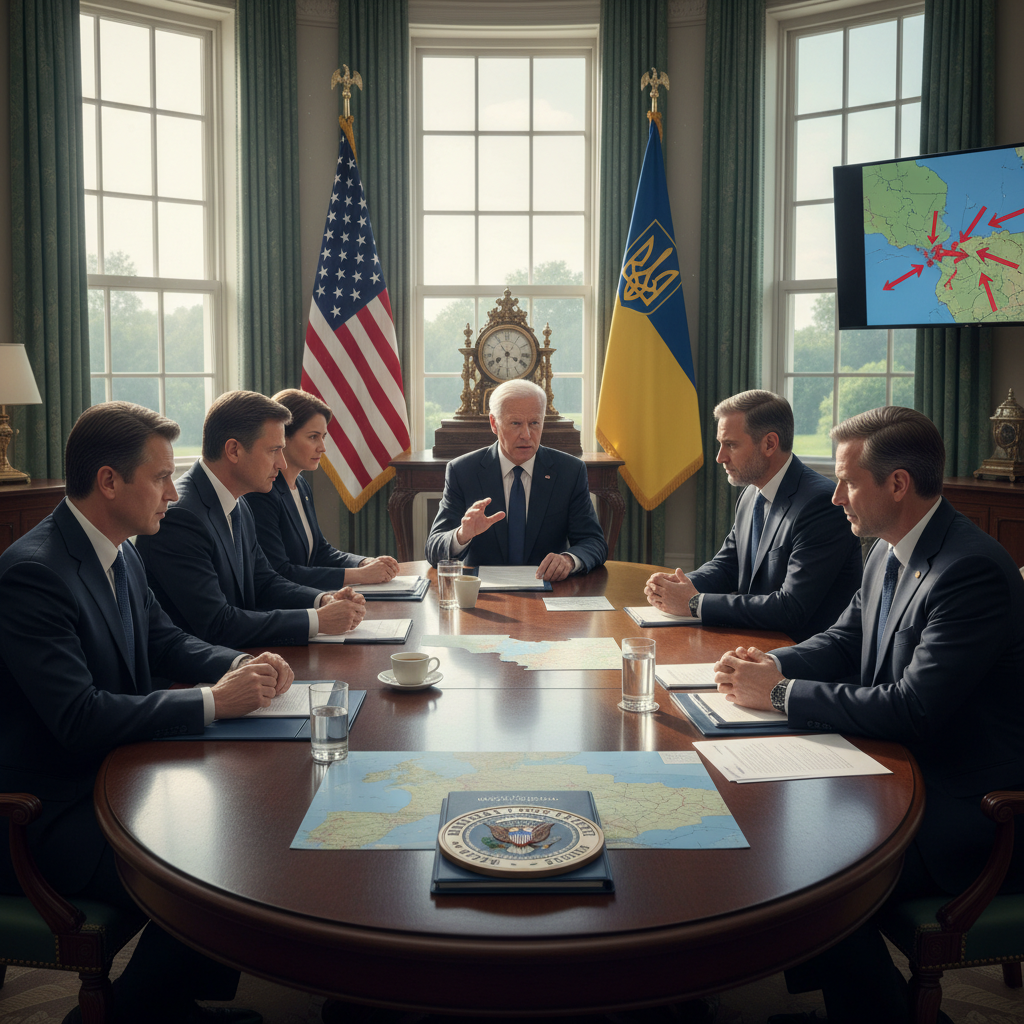
Speaking at the White House alongside Trump and European leaders, Zelenskyy stressed that security guarantees remain at the core of Ukraine’s survival and future independence. “The first one is security guarantees. And we are very happy with President [Trump], that all the leaders are here, and security in Ukraine depends on the United States and European countries,” Zelenskyy said. He added that Washington’s readiness to extend strong signals of support was “very important,” though he stopped short of clarifying what those guarantees might look like.
Trump echoed the sentiment of security but again prioritized Europe, bearing most of the burden. He also pushed the idea that territory must be discussed if this war is to end. “We’re going to help them, and we’re going to make it very secure,” Trump said. “We also need to discuss the possible exchanges of territory, taking into consideration the current line of contact. That means the war zone, the war line center.”
Leaders of European countries met at the White House over Ukraine, showing sharp divisions over how to balance peace and support for Ukraine. Trump still had a relatively friendly relationship with Zelenskyy, despite clashing on issues like territorial concessions.
Sanctions, Ceasefire Debate, and NATO
On Capitol Hill in Washington, lawmakers were toughening their calls for sanctions, especially on economic and trade issues. One idea, from South Carolina Senator Lindsey Graham, would authorize Trump to levy tariffs as high as 500 percent on any country that continues buying oil from Russia. He suggested the EU and other major oil consumers should share the U.S.’s approach to Russian energy. “My advice to President Trump and [Secretary of State Marco Rubio] is, you’ve got to convince Putin that if this war doesn’t end justly and honorably with Ukraine making concessions also, we’re going to destroy the Russian economy,” Graham told Fox News. China, in particular, had a lot of leverage over Putin. “The second most important person on the planet to end this war is President Xi in China,” Graham said, but made clear that Washington will have to pressure China itself to change course.
In some ways, Trump has been willing to embrace tariffs as a tool of war, already slapping India with a 50 percent tariff in August due to its oil purchases from Moscow. Graham’s bill, co-sponsored with Republican Senator Rick Scott of Florida, suggested that threatening the same treatment for China could be enough to turn the tide.
In Europe, the EU agreed to a new sanctions package targeting Russia, its 19th overall. The new measures will be approved later this month and seek to further isolate Moscow on the economic and financial fronts. That would include efforts to further cut off Russia’s energy revenues and banking access, as well as hobble its military-industrial base and plug many of the gaps that Moscow has used to evade existing measures. Over the past three years, Western nations have ramped up their use of sanctions so much that Russia is now the most sanctioned country in modern history, even more isolated than Iran, North Korea, or Venezuela.
Sanctions are just one piece of the pie, however. European leaders also made the case to Trump that a ceasefire must be in place before any negotiations have a chance of success. German Chancellor Friedrich Merz, like many in the EU, argued that a temporary ceasefire was needed before serious negotiations could even begin in order to give the talks credibility. “I can’t imagine that the next meeting would take place without a ceasefire,” Merz said. Trump’s view is that ceasefires just give Russia time to rebuild. “You have a ceasefire, and they rebuild and rebuild and rebuild,” he said. “But you do have to go to a ceasefire at one point in time,” Trump later added.
Finland’s new president, Alexander Stubb, who took office in March of this year, also sat down with Trump in the White House meeting. Stubb, who has been in the private sector working on business since he left office, has been openly skeptical of Russian President Vladimir Putin’s commitment to observing a ceasefire. Finland has an 800-mile border with Russia. That’s a fact. So we cannot deal with this conflict without considering our history,” Stubb said in a recent interview. He has been one of the more pro-Trump figures in Europe and was seen as one of the president’s best interlocutors in the European Council. “If I look at the silver lining of where we stand right now, we found a solution in 1944, and I’m sure that we’ll be able to find a solution in 2025 to end Russia’s war of aggression.”
Trump has also been honest about his conditions for peace and disarmament, and their cost. Writing on Truth Social, he took to task Ukraine’s Zelenskyy for refusing to make the concessions he wants: formal relinquishing of Crimea, which Russia annexed in 2014, and a pledge never to join NATO. “President Zelenskyy of Ukraine can end the war with Russia almost immediately, if he wants to, or he can continue to fight,” Trump wrote. He blamed his predecessor, the Obama administration, for “giving” Crimea to Putin without a fight more than a decade ago. Trump also warned that “NO GOING INTO NATO BY UKRAINE” would be a line he would not cross.
The opposing positions Zelenskyy and Trump have staked out on the question of long-term guarantees reflect deep divisions in Washington and Europe over the best path toward ending this war. With sanctions expected soon, possible tariffs and pressure on both Russia and China, and continued battlefield fighting, there are more hurdles than there are clear paths to peace.