- calendar_today August 7, 2025
The Rise of AI in Entertainment – How It’s Changing Music, Movies, and More in California
California’s Music Scene Is Getting a Tech Boost
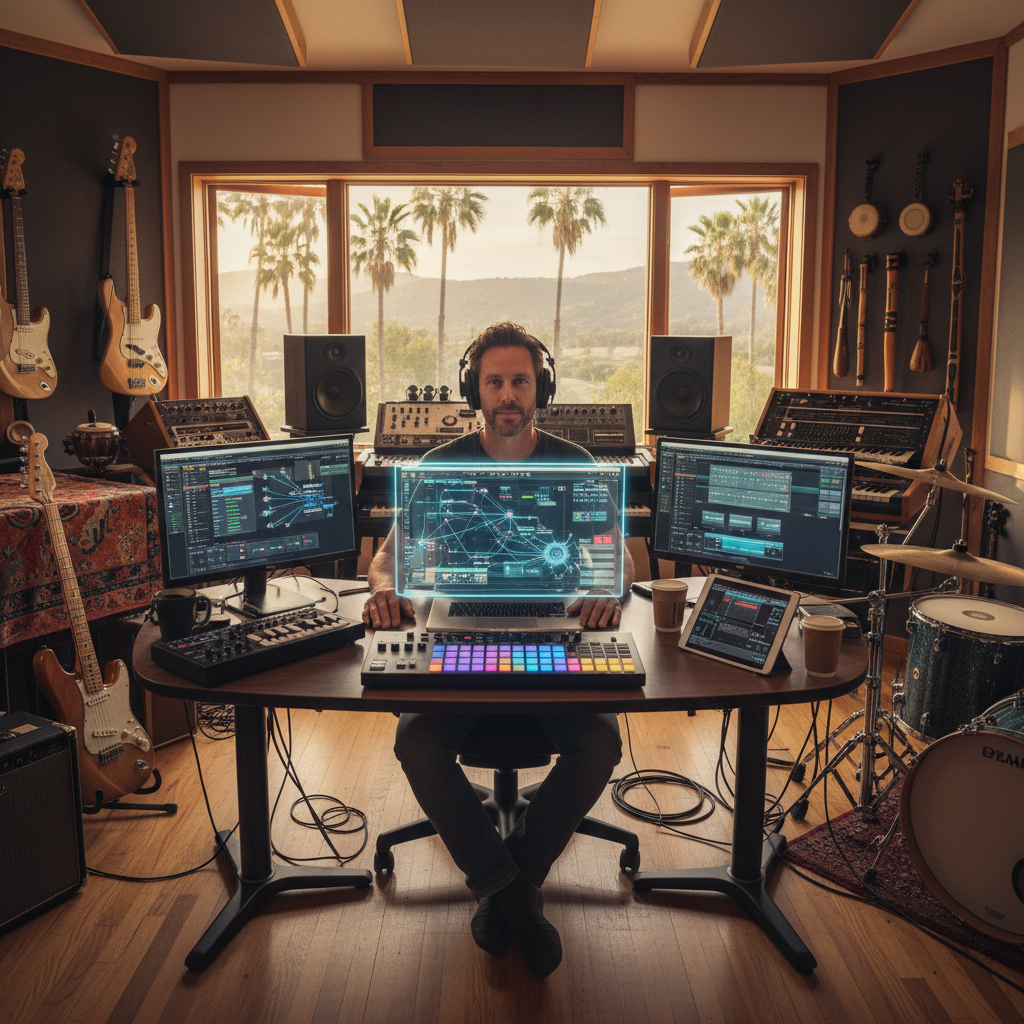
California has always been a musical trendsetter. Whether it’s the surf rock of the ‘60s, Bay Area hip-hop, or L.A.’s ever-evolving pop sound, this state lives and breathes music. Lately, though, more artists—especially indie and underground acts—are experimenting with AI music tools to get a creative edge.
A producer I met in Oakland said he uses AI to brainstorm drum patterns when he hits a creative block. “It doesn’t write my songs,” he told me, “but sometimes it throws out an idea that makes me think differently.” In true California fashion, it’s not about rules—it’s about what works in the moment.
Filmmakers in the Golden State Are Getting Smarter with Tech
From student films in Santa Cruz to major productions in Burbank, AI is creeping into filmmaking workflows all over California. Writers are using it to outline scripts. Editors are leaning on it for faster cuts. And indie teams, especially, are grateful for tools that help them do more with less.
One filmmaker in L.A. shared how AI helped him clean up his audio and automate some color correction. “It saved me days,” he said. “And it didn’t touch the story—I still controlled that part.” That’s a common theme here: efficiency without surrendering creative vision.
Visual Art Is Getting a Digital Companion
Galleries in San Francisco and street artists in Venice Beach are starting to show work that incorporates AI-generated visuals. But it’s not cold or soulless—it’s surprisingly human.
I visited a space in Echo Park where the artist used AI to reimagine California landscapes as surreal dreamscapes. “It helps me see what I didn’t know I was looking for,” she said. AI, in this case, wasn’t a replacement for intuition. It was a spark.
California Students Are Blending Code with Creativity
At places like Stanford, UCLA, and CalArts, students are exploring AI-powered storytelling in ways that blur the line between tech and art. They’re building games where characters evolve, writing scripts with machine-generated dialogue prompts, and designing exhibits that respond to voice or motion.
At a showcase in Berkeley, I saw a student’s short film that changed endings based on audience reactions in real time. “We wanted the audience to shape the story,” he explained. That kind of experimentation is baked into California culture—always pushing, always rethinking the rules.
Some Creators Still Have Their Doubts
Not everyone’s excited about this shift. In a state that prides itself on authenticity and expression, some artists worry about losing their voice in the noise of machine-made content.
A singer-songwriter in Santa Barbara told me she tried AI to write a verse and immediately deleted it. “It sounded fake. Too perfect,” she said. “I’d rather mess up and make it mine.” That tension is real—and in California, where personal identity is often part of the art, it’s something many are still wrestling with.
AI Helps, But People Still Drive the Vision
Despite the fears, most creatives here are using AI as a sidekick—not a replacement. It helps speed up the boring parts, test new directions, or offer suggestions. But the heart of the work? That still belongs to the human holding the brush, mic, or camera.
A digital artist in San Jose said it best: “I don’t want AI to create for me. I want it to challenge me.” That mindset—collaborative, experimental, but grounded—is very California. It’s not about being wowed by tech. It’s about using it to dig deeper.
Final Thoughts
California has always been a place where creativity meets innovation—and this moment with AI is no different. Whether it’s helping a student reimagine film structure or giving a seasoned producer a fresh angle on a beat, AI in entertainment is just another tool in the box.
But here, it’s not the tool that defines the work. It’s the vision, the story, the voice behind it. And in California, that voice still matters more than anything.