- calendar_today August 12, 2025
.
Washington and New Delhi once believed they had crafted the most robust post–Cold War partnership. But now, one of their “best” relationships is on life support after President Donald Trump’s tariffs have caused Delhi to cozy up to Moscow and Beijing.
In interviews with FP, experts described a U.S.-India relationship on life support, the trust between the two countries completely gone.
“The lack of trust is extraordinary,” said Evan Feigenbaum, a South Asia expert at the Carnegie Endowment for International Peace. “We’re in a situation in the U.S.-India relationship where the premises and assumptions of the last 25 years — that everybody worked very hard to build, including the president in his first term — have just come completely unraveled.”
Last month, Trump announced a 25 percent tariff on Indian imports starting this month and increasing to 50 percent on August 27. In New Delhi, many of the tariffs have been dismissed as “commercial retaliation” against India, which continues to buy oil from Russia despite Putin’s invasion of Ukraine.
“The assumption that we have been living with over the last several years, starting with the Obama administration and continuing into this administration, is that India’s interests and American interests are as closely aligned as they’ve ever been in the post-Cold War era,” Feigenbaum said. “And it’s now clear that that is just not the case.”
India has held talks with Putin in recent weeks, and visits by national security adviser Ajit Doval and Foreign Minister Subrahmanyam Jaishankar were “sending an unambiguous message of solidarity with Russia and distancing from the West, particularly the U.S.,” Michael Kugelman, a South Asia analyst at the Washington-based Wilson Center, told FP.
Kugelman said India will continue to play both sides. “I think they’re just looking to hedge and sending very clear signals to China that they’re not going to be lectured to and that there are limits to the self-discipline India is prepared to exercise when it comes to China.”
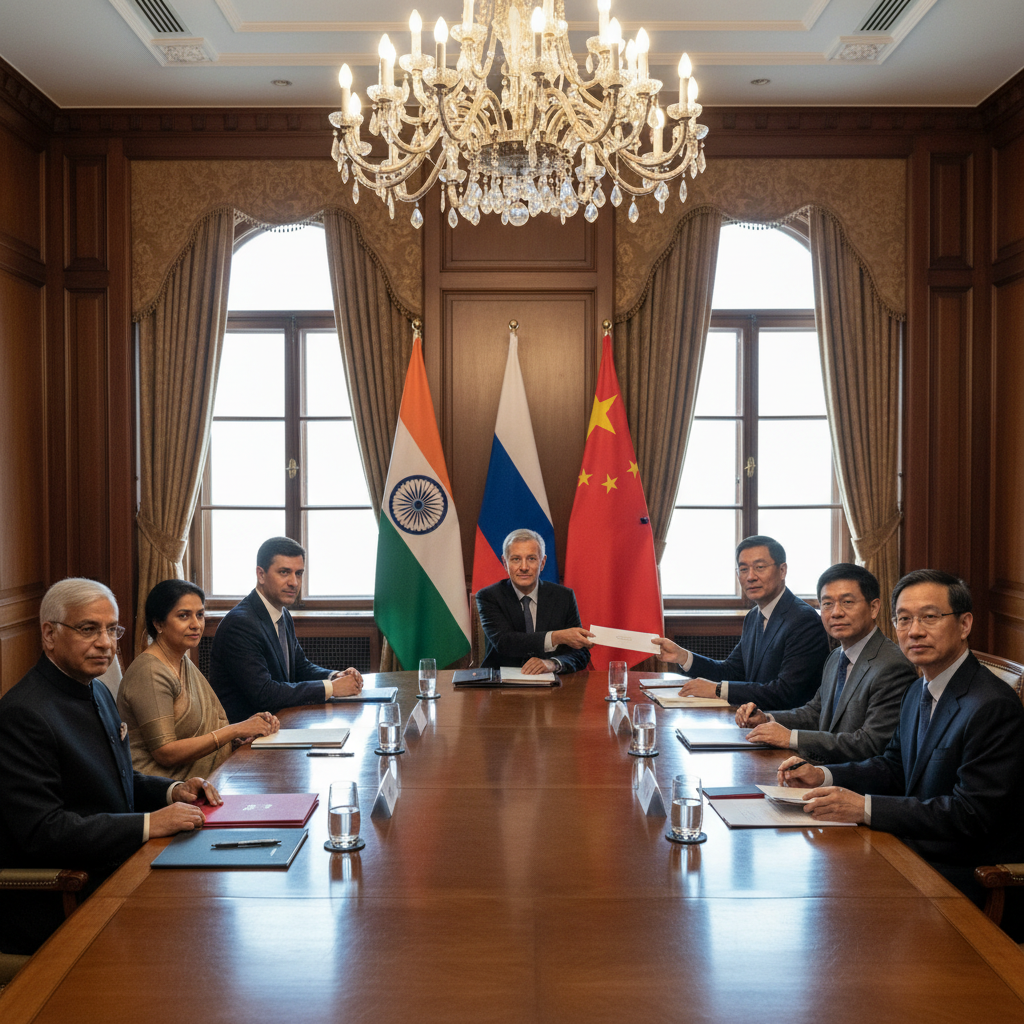
Last week, Chinese Foreign Minister Wang Yi visited New Delhi and completed discussions with Jaishankar, marking the first high-level meeting between the two nations’ foreign ministers since the border skirmishes last year. In August, Modi will visit China for the first time in over seven years. Russian President Vladimir Putin has also extended an invitation to Modi and is expected to host him at his summer residence in the Black Sea city of Sochi before the end of the year.
“What’s striking to me about all this is it’s not just symbolism. It has an impact on Indian public opinion,” Feigenbaum said. “They’re signaling very clearly that they view that as interference in India’s foreign policy, and they are not going to put up with it.”
Analysts told FP the impact on the U.S.-India relationship over New Delhi’s oil purchases from Russia has been “cumulative and intentional,” and Modi has likely concluded that Washington “can’t be trusted.”
Modi has taken to the stump at home to claim credit for dodging U.S. pressure to avoid Russian oil, characterizing his refusal as a moral victory for India’s sovereignty. His administration has also justified buying oil from Russia by prioritizing the livelihoods of farmers, small businesses, and young workers, which is a message with high domestic political value.
Kugelman recalled that New Delhi had already made significant concessions to Washington, including tariff reductions and the forced repatriation of Indian workers from the United States during the pandemic. “Because of those concessions, India needs to be careful about signaling further willingness to bend. This is one reason there was no trade deal — Modi put his foot down,” he said.
In an op-ed for the Financial Times, former White House trade adviser Peter Navarro, a chief architect of Trump’s trade war with China, echoed these sentiments, writing, “Indian oil purchases from Russia … are opportunistic, deepening U.S. distrust and corrosive to a partnership upon which the future of the world will rest.”
Trump’s tariffs are not the only reason India has moved closer to Russia and China, Feigenbaum and Kugelman noted. New Delhi has been looking east for years, and with China, the shift is “as much about economics as anything else,” Kugelman said. “You had already seen India wanting to start mending fences with China well before Trump took office. He just accelerated things.”
Feigenbaum noted that “India is going to double down on some aspects of its economic and defense relationship with Russia — and those parts are not performative.”
While New Delhi has diversified its purchases of Russian arms with systems from the United States, France, and Israel, Russian energy trade has spiked since the Ukraine war began. Kugelman, therefore, described the current shift toward Russia as “a validation of India’s long-held belief that the U.S. can’t be trusted, whereas Russia can — because Russia is always going to be there for India no matter what.”
Kugelman described a special summit between Modi and Putin earlier this year as “as much a photo-opportunity as anything else. But on the Russian side, we’re already seeing some announcements of projects with India. Deputy Prime Minister Denis Manturov was just in New Delhi last week and said Moscow will continue to ship crude, oil products, thermal, and coking coal. But it’s also now talking about the potential for the export of Russian LNG to India.”
By contrast, analysts and former officials said there is a sense of frustration among current and former Trump administration officials. Navarro, Trump’s trade adviser who left the White House in January 2021, also wrote that India was “now standing on the wrong side of history” and that American tariffs against New Delhi are “absolutely” necessary to “cut off the financial lifeline that the Indians are so brazenly and shamelessly extending to Russia’s war effort.”