- calendar_today August 14, 2025
.
Electric vehicle (EV) adoption in the U.S. is being met with new headwinds after slowing sales and other challenges dampened momentum. EV sales have now declined for the first time in over a year after months of month-on-month growth. After buyers shunned electric models, both Genesis and Volvo have plans to scale back their EV lineups.
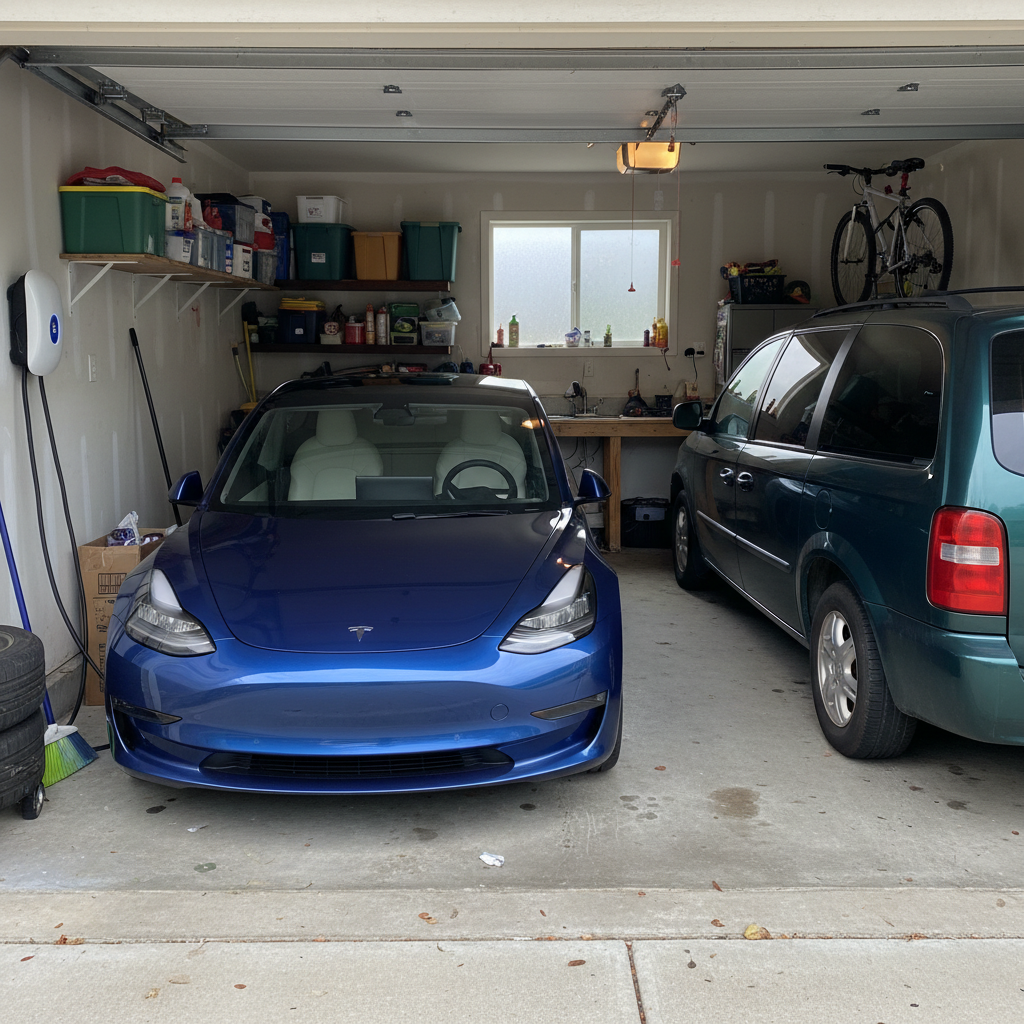
Things got worse for the industry when the current administration in Washington trimmed subsidies and rolled back vehicle pollution standards, leaving fewer federal incentives for consumers. But industry analysts say the biggest hurdle for EV adoption may not be Washington, D.C.—it may be in your garage.
Plug in at Home
For years, consumer surveys have pegged range anxiety and charging to be the number one issue holding back EV adoption. A new market study from Telemetry Vice President Sam Abuelsamid delves into the issue of charging and finds an often-overlooked factor at play: garage usage.
Fast charging public infrastructure has dominated the EV charging narrative of late, but most charging still takes place at home. AC power remains the workhorse of EV charging, with an estimated 80 percent of all EV charging done at home, often from a single-family residence (SFR). Data from the National Renewable Energy Laboratory (NREL) found that 42 percent of SFR owners already park near an outlet capable of supporting the more efficient level 2 (240-volt) charging.
“The 42 percent figure could double to 68 percent, if households that don’t currently have access to level 2 charging opened up their garages for home charging and/or modified their parking behavior,” Abuelsamid says.
Telemetry calculated that 90 percent of all houses could add a 240 V outlet near where cars could be parked. Parking behavior, namely whether homeowners use a private garage for parking or storage, will likely become a key factor in EV adoption. This will be more challenging to ascertain, but understanding consumer behavior and changing attitudes toward how and where they park will be important in determining future adoption rates.
Unlocking Homes for Charging
Factoring in parking behavior, Telemetry finds that opening up more garages to parking instead of storage could more than double the number of homes capable of EV charging from 31 million to over 50 million. If you include SFRs where the wiring is likely to be possible but not yet present, then that number rises to more than 72 million. This already exceeds the firm’s most optimistic forecast of EV penetration for 2035, which is 33 to 57 million vehicles.
While the number of charging-capable homes is large, it’s important to note that these homes are not necessarily ready for charging on Day 1. The same NREL study showed that nearly 34 million homes would require an electrical panel upgrade to support a 240 V charger (these typically draw at least 30 amps). Upgrades can be as simple as new wiring to as extreme as an entirely new panel, which can run homeowners thousands of dollars.
Unclogging the Multifamily Housing Pipeline
For the 23 percent of the population living in multifamily dwellings (apartments, condos, townhomes, etc. ), the barriers to home charging are even steeper. Individual EV owners typically do not have the autonomy to install chargers in these environments, so they must rely on landlords, management companies, or co-op boards to install. Approval for charging is by no means a foregone conclusion.
The barrier to entry is also higher. A landlord or building manager may need to spend millions upgrading the entire electrical panel for a co-op before they could even run the wiring to share a pair of level 2 chargers. Wiring and installing chargers for a distant parking space would further add to this cost. The residents in these homes are also frequently not eligible for municipal or utility subsidies that may be available to SFR owners to defray the cost of installation.
EVs in Multifamily Housing
While about 1 million EVs are currently in multifamily housing, only 11 percent are parked close enough to an outlet to charge. States have been mandating that 20–25 percent of parking spaces in new developments be EV-ready, but Telemetry still only estimates between 6.7 million and 11.4 million charging-capable spaces in multifamily dwellings by 2035. That number is expected to be eclipsed by demand.
Public Charging Will Fill the Gap
With space at home limited, the public charging infrastructure will be key to making up the difference. Telemetry estimates that between 11.7 million and 14.3 million EV drivers that own a house will still use public charging in 2035. Another 7.8 million to 8.1 million EV owners living in multifamily residences will be similarly dependent on public charging.
Supplying that demand would require between 523,000 and 586,000 DC fast chargers, with another 1.5 million to 1.6 million level 2 chargers nationwide. The economics of expanding this infrastructure will not be easy either, with power companies already strained. New AI data centers will compete for the same generation and distribution capacity that large-scale charging sites will require.
The Next Hurdles for EVs in the U.S.
The path forward for EVs in the U.S. is not as clear as it may seem on the surface. Despite the millions of homes that could technically support EV charging, the potential limiting factors of garage clutter, high electrical upgrade costs, and the lack of easy access to charging for residents of multifamily housing suggest the rate of EV adoption may not be as brisk as some would hope. The desire to avoid paying for charging infrastructure, with or without subsidies, could also limit adoption. Expanding public charging would be needed to fill the gap, but the coming demand may outpace the coming supply, at least in the next decade.
Homeowners’ garages and parking habits may be as important as federal or automaker initiatives as a determinant of the future of electric vehicles in America.