- calendar_today August 17, 2025
Fantastic Four’s Greatest Threat? A Lack of Urgency
Marvel’s The Fantastic Four: First Steps is a well-acted and highly stylized homage to one of its earliest superhero teams. Characters stare into pixelated space while shouting superpowered insults at one another, engaging in combustible brawls choreographed like a ballet of fire and brimstone. The aesthetic is a loving, midcentury homage to 1960s Marvel Comics, and it’s backed up by performances that often ring true, especially in scenes featuring Pedro Pascal and Ebon Moss-Bachrach. But as retro-cool as it often is, there’s not a lot at stake in this reboot, and the thrilling moments that the film teases never quite arrive.
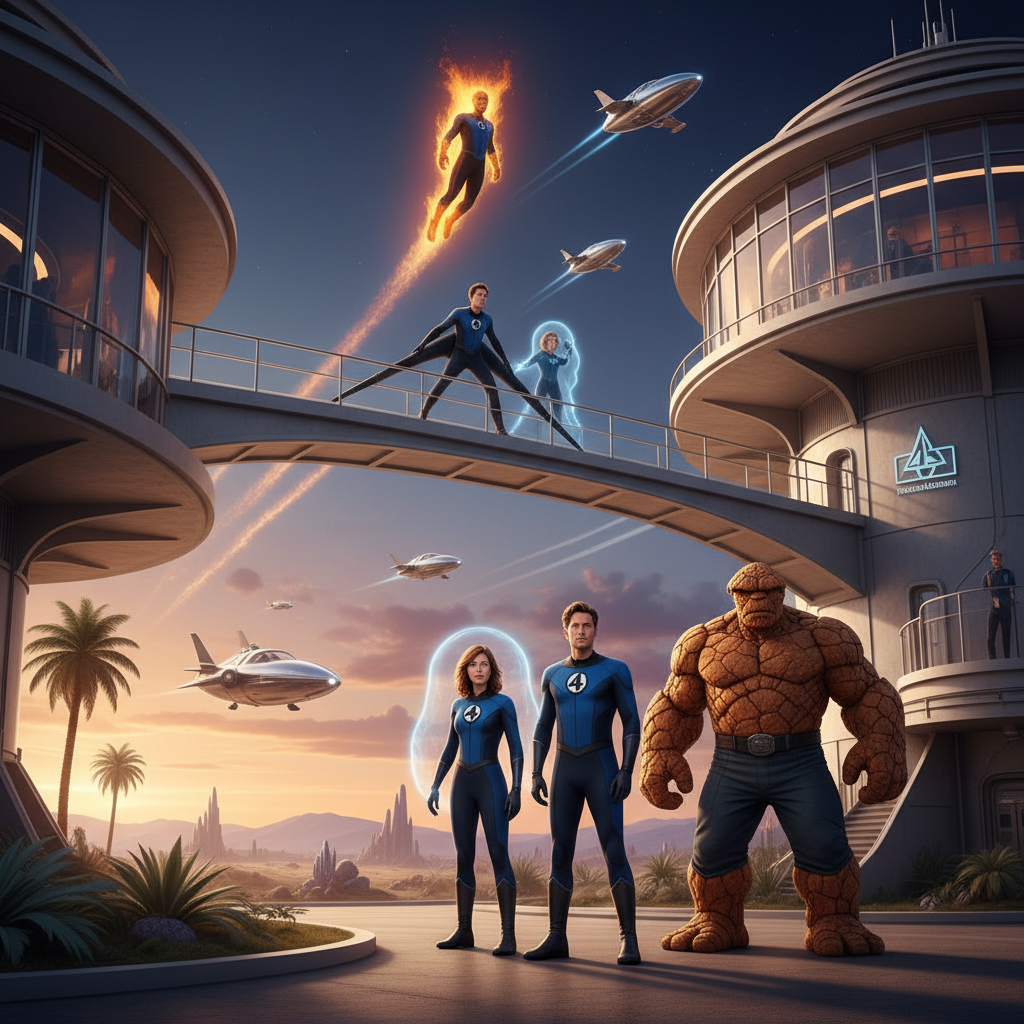
The Fantastic Four: First Steps begins with a little exposition courtesy of Mark Gatiss, who plays a talk-show host who briefly summarizes how the Fantastic Four got to be the Fantastic Four. The main characters were on a joint space mission four years ago when they were exposed to radiation in deep space. Their DNA was altered, and they gained superpowers. Reed (Pedro Pascal) can stretch his body out like a rubber band, Vanessa Kirby’s Sue Storm can turn invisible and project force fields, Joseph Quinn’s Johnny Storm is the Human Torch, able to ignite his body and fly, and Ebon Moss-Bachrach’s Ben Grimm is The Thing, a large, rock-covered man with incredible strength.
They live together in a kind of mid-century-modern space compound, with flying cars and chalkboard equations decorating their walls. They’ve got a toddler-sized robot named H.E.R.B.I.E. who seems to vacuum up their floors in between various other chores. The world of The Fantastic Four: First Steps is retro-futurism run amok. Everything about it, from the design of its set pieces to the square shape of its television screens to the characters’ slacks-pocket pens and all-around cheerful camaraderie, is from a time when phones had cords and Americans thought they were going to the moon. To watch the movie is to watch The Jetsons and Lost in Space have a baby with Marvel Comics.
Galactus, a gargantuan armored figure with oversized glowing eyes, is on his way to Earth with one mission: to consume it. Before he arrives, he sends a herald, a lithe woman with silver skin (Julia Garner in motion capture), to act as an envoy and tell the people of Earth that their time is up. She arrives, gliding in like a wraith of razor-edged menace, but her presence soon becomes overshadowed by a combination of adolescent lust (Johnny is smitten) and the threat of danger. (Galactus’s heralds get snarky names: this one is called Carol.)
Galactus himself is less menacing than ominous, at least from afar. (Getting closer to him ends badly.) With the Silver Surfer blazing her warning across space, Galactus flies in to begin the End Times. Reed and his band of errant geniuses decide that their best course of action is to just track him and get in front of him to keep Earth in his path. Thus, they take off after Galactus as he barrels toward the planet, firing red-hot salvos of energy at the Fantastic Four and blasting glowing pillars of silver light at anything in his path.
Visually, even the action is consistent with the movie’s aesthetic. Planetary smash-ups are signaled by pops of cherry light; flame and exhaust trails from flying cars are straight out of Saturday morning cartoons. Scenes depicting The Fantastic Four beating the holy crap out of each other are explosions of color, with conveniently stylized puffing rings and lava rocks shooting from punches.
It’s a choreographed mess, but an earnest one. And when, in the climactic battle, Sue goes into labor right as the Fantastic Four are blasting away at Galactus’s planet-consumption space engine, it’s hard to figure out how to register the scene. Is it a birthing scene? A planet-blowing-up scene? A hot-pink color scheme? Sue gives birth in space. Galactus’s herald briefly gets abducted into his home dimension as a surprise reward. The Fantastic Four hug and bicker as always.
There’s something strange about the matter-of-fact way in which the events of The Fantastic Four: First Steps are resolved. It’s fitting, perhaps, for a film that mostly resists drama. The consequences of the Fantastic Four and Galactus’s battle are neatly contained and all too quickly wrapped up. (Galactus just leaves the Earth alone? Did he eat Mercury instead?) But there’s not much at stake when it feels like there’s a third act waiting in the wings. Earth won’t be swallowed, Reed will be a doting if kind of absent father to his son, Sue will be a mom, and the Fantastic Four will go on to have more kiddos, and hopefully more space brawls, in future sequels.
In all, The Fantastic Four: First Steps has echoes of some of Marvel’s finest: the quiet but still epic cosmic threats of Thor and the Guardians of the Galaxy; the family dramas and sentient doomsday devices of the first Avengers. But it rarely achieves the immediacy or the stakes that those movies have, for better or for worse. The Fantastic Four: First Steps is an easy watch. But for Marvel, it’s unthrilling.