- calendar_today August 10, 2025
Flames in the cabinet of wonder: MJT suffers fire damage
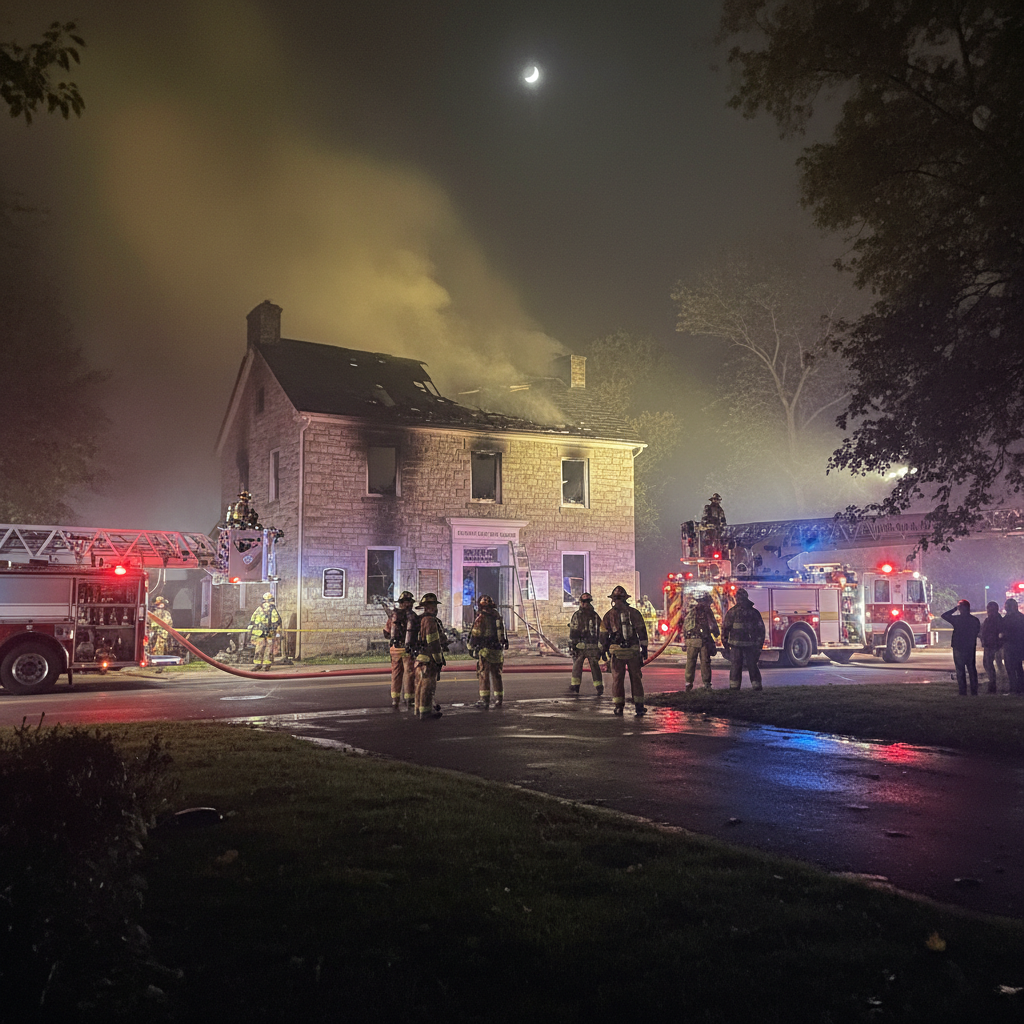
One of Los Angeles’s most unusual cultural institutions, the Museum of Jurassic Technology (MJT), suffered a serious fire last month that damaged a building and destroyed its gift shop. The fire, which started at around 10 pm on July 8, left the museum with widespread smoke damage and several closed exhibits. Revenue losses during the museum’s closure are anticipated to total around $75,000, with a reopening planned for some time next month.
MJT in Culver City has long been a singular but beloved destination in the LA area. Established in 1988 by David Hildebrand Wilson and Diana Drake Wilson, it has since drawn visitors with deliberately confusing and occasionally questionable exhibits. The museum purports to be “dedicated to the advancement of knowledge and the public appreciation of the Lower Jurassic.” But while the MJT may be interested in many of the same things museums are, it is, in actuality, not much concerned with the Lower Jurassic. Instead, it is an institution inspired by the wunderkammers, cabinets of curiosity from the Renaissance era that were among the first modern museums.
MJT’s reputation over the decades has since solidified around an impression that while its exhibits may not be entirely truthful or fictional, they are always multilayered and highly detailed. The museum contains several genuine historical objects, but does an excellent job of blurring the line between fact and fiction in such a way that many visitors can’t be sure what is real and what is not. Some of the museum’s permanent exhibits feature the work of historical figures, such as one that pays homage to 17th-century polymath and Jesuit priest Athanasius Kircher or another one that showcases the works of Hagop Sandaldjian, a 20th-century Armenian sculptor who made ultra-miniature sculptures so small they are placed in the eye of a needle and carved from one human hair at a time.
Some of the other exhibits at the MJT, meanwhile, push the bizarre even further. There is a room full of decomposing dice once belonging to the late magician Ricky Jay and “The Garden of Eden on Wheels,” a visual survey of trailer parks in the greater LA area. It also contains stereographic radiographs of flowers, microscopic mosaics made from butterfly wing scales, and a rather odd collection of letters written to the Mount Wilson Observatory by amateur astronomers in Southern California from 1915 to 1935. In 2005, the museum even opened a Russian tea room modeled after the study of Tsar Nicholas II in St. Petersburg’s Winter Palace.
Firefight and Aftermath
The latest incident was recently reported in detail in an essay published by writer Lawrence Weschler, whose 1996 book, Mr. Wilson’s Cabinet of Wonder, investigated the origins of many of MJT’s exhibits. The fire was reportedly first noticed by David Wilson, who also lives in a house behind the museum. “I saw flames in the building,” Wilson later told Weschler of the fire he spotted that night. “There was a ferocious column of flame shooting out of the top corner of the wall facing the street.”
Wilson, who had two fire extinguishers at the ready, was able to get to the museum in time but unfortunately found that the extinguishers he had were not large enough to put the fire out on their own. Luckily, his daughter and son-in-law had just arrived minutes later with a larger extinguisher and were able to put out the flames just before the firemen arrived on the scene. The firefighters later told Wilson that if they had arrived just one minute later, the entire building would likely have burned down.
Though much of the structural damage was localized to the gift shop, smoke had made its way throughout the building. Wilson said that upon entering MJT, he “knew the museum had suffered what could only be called a terrible despoliation,” comparing the effect of the smoke to “a thin creamy brown liquid… evenly poured over all the surfaces—the walls, the vitrines, the ceiling, the carpets, and eyepieces, everything.” Smoke infiltration is one of the worst kinds of damage for a museum, and especially difficult to clean in a place that prides itself on detail and presentation. The museum’s staff and volunteers have been working nonstop to clean and repair the damage, which is said to be a slow and laborious process.
In the meantime, Weschler has asked that supporters consider donating to the museum’s general fund in order to help rebuild and make up for the loss. He further added that the MJT is “one of the most truly sublime institutions in the country,” which “remains in its eccentric singularity one of the most generous, as well as the most wildly original places we have.”
It is unclear when the museum will reopen. Still, it is expected that it will soon return to its unique state, a place difficult to pin down, that defies science, art, and even narrative in ways that are equal parts satire, scholarship, and surrealism.