- calendar_today August 10, 2025
LA’s surrealist museum grapples with fire aftermath
One of Los Angeles’s most curious cultural institutions, the Museum of Jurassic Technology (MJT), is still recovering after a nighttime fire caused significant damage to the building earlier this month. The blaze, which occurred late on July 8, destroyed the museum’s gift shop and caused smoke damage throughout much of the rest of the museum. Loss of revenue during the museum’s closure is estimated to cost as much as $75,000; it is hoped that the museum will reopen at some point next month.
The MJT in Culver City has long had a cult-like following within LA’s arts and culture scene. Opened in 1988 by David Hildebrand Wilson and Diana Drake Wilson, the museum’s exhibits are purposefully confusing and often self-consciously disreputable. The museum describes itself as being “dedicated to the advancement of knowledge and the public appreciation of the Lower Jurassic,” but it has little to do with that particular period of geologic time. Instead, it is modeled after cabinets of curiosity from the Renaissance, also known as wunderkammers, some of the earliest forerunners of the modern museum.
Over the decades, the MJT has cultivated a kind of meta-literary reputation for the presentation of its exhibits. While some are entirely straightforward and even historically significant, others are curiously fictional, and in some cases, visitors can be hard-pressed to tell fact from fiction. For instance, one of the museum’s long-time exhibits is dedicated to the polymath and Jesuit priest Athanasius Kircher, a real 17th-century figure who had a documented interest in seemingly everything, from music to mathematics to astronomy. Another permanent exhibit is a showcase of the ultra-miniature sculptures of Armenian-American artist Hagop Sandaldjian. The sculptures are so small that they are displayed in the eye of a needle and are carved from a single human hair.
The museum also contains exhibits that delve deeper into the weird. One case holds a collection of decomposing dice that once belonged to magician and entertainer Ricky Jay. Another is a display called “The Garden of Eden on Wheels,” a photographic survey of Los Angeles-area trailer parks. Other exhibits include stereographic radiographs of flowers, microscope mosaics assembled from butterfly wing scales, and a strange collection of letters from amateur astronomers to the Mount Wilson Observatory written between 1915 and 1935. Since 2005, the museum has even housed a Russian tea room modeled on the study of Tsar Nicholas II at the Winter Palace in St. Petersburg.
Firefight and Aftermath
A more detailed account of the fire has since been published by writer Lawrence Weschler, author of the 1996 book Mr. Wilson’s Cabinet of Wonder, which dissects the authenticity of many of MJT’s exhibits. In that article, Weschler relates that the fire was first noticed by David Wilson, who lives in a home located immediately behind the museum. Seeing flames in the building, Wilson made a run for it with two fire extinguishers, arriving at the museum shortly before the Los Angeles County Fire Department.
“The first thing I saw,” Wilson recounted to Weschler, “was a ferocious column of flame going straight up. I rushed up to the corner of the building where there’s a little balcony that’s at the edge of the front street window. I tried to get it with my extinguishers, but the stream was too weak. By the time I tried to get closer and got my face to the window, the fire had started to encroach around the corner, so I raced around the other side. But it was the same story: you’re standing at the base of this column of fire with your extinguisher, and it’s kind of a heartbreaking experience.”
At that point, Wilson’s daughter and son-in-law arrived on the scene with a larger fire extinguisher and were able to contain the flames, with help from firefighters who had just arrived moments later. Firefighters later told Wilson that the building would likely have been completely lost if they had arrived one minute later. Smoke from the fire, however, spread through the museum; as Wilson told Weschler, “it was as though someone had taken a thin creamy brown liquid and poured it evenly over all the surfaces—the walls, the vitrines, the ceiling, the carpets, and eyepieces, everything.”
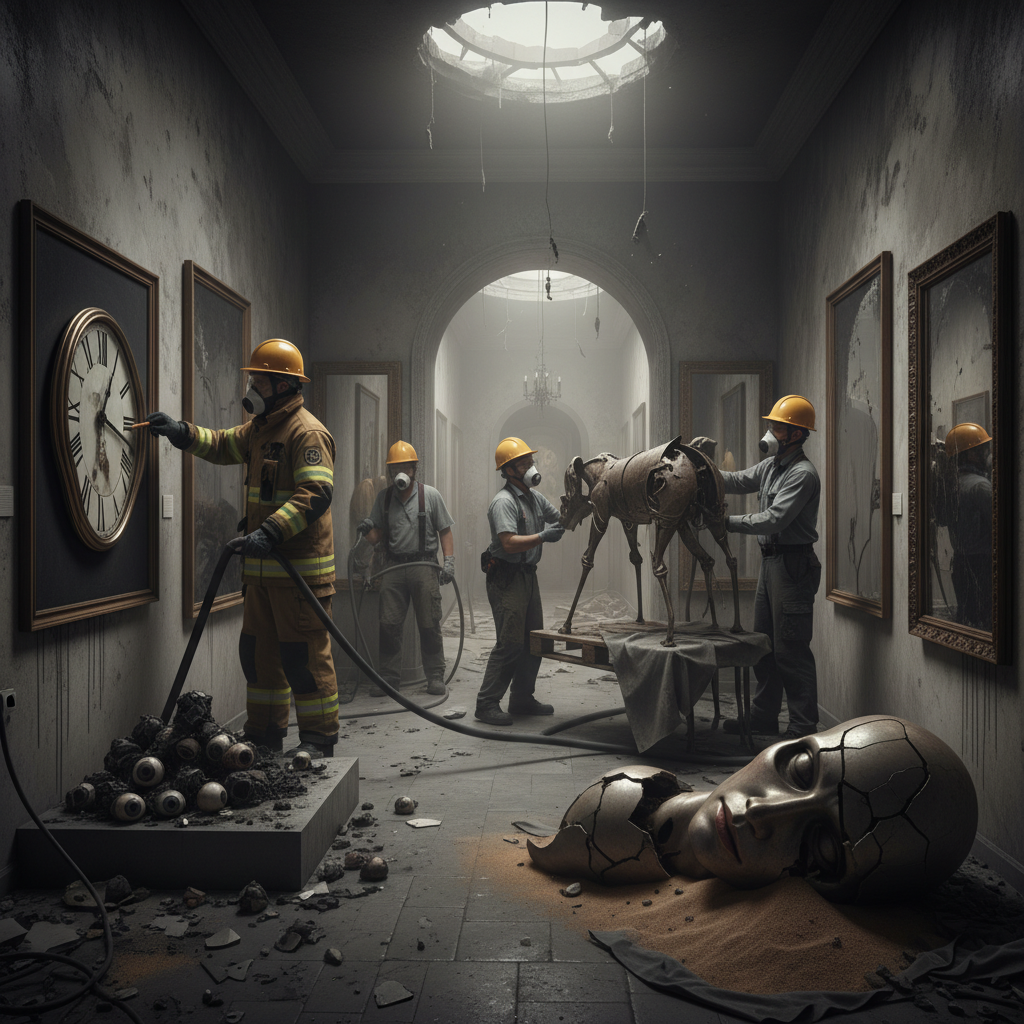
The museum has since been undertaking a tedious and laborious process of remediation. Staff and volunteers have worked to clean and mitigate the smoke damage in the hope that some of the more exotic exhibits can be salvaged from the damaged display cases. In the meantime, Weschler has made a public appeal for donations to the museum’s general fund in order to cover lost revenue as well as pay for clean-up and restoration.
The timeline for the museum’s reopening remains to be seen. There is some optimism, however, that it will re-emerge as bitingly quirky and more resilient than ever.