- calendar_today August 24, 2025
The Sandman Finale Brings the Dreaming Full Circle
For anyone who read Neil Gaiman’s seminal graphic novel series of the same name, The Sandman’s first season on Netflix was a treat. The showrunners, led by Allan Heinberg, were successful in mirroring the original comic’s hallucinatory tones and textures. In addition to coming to life in a way that feels both familiar and fresh, the pacing and presentation of the season also managed to strike a balance between being an anthology series in the vein of the original comics and sticking to a story centered on the arc of its protagonist, the Dream King Morpheus. With the second and final season of The Sandman now streaming, here’s what to expect.
Season 1 adapted two classic Sandman story arcs, Preludes and Nocturnes and The Doll’s House, as well as two bonus episodes based on two Dream Country short stories: “Dream of a Thousand Cats” and “Calliope.” Season 2, as far as story arcs go, pulls primarily from Seasons of Mists, Brief Lives, The Kindly Ones, and The Wake. Key stories from Fables and Reflections, specifically “The Song of Orpheus” and the first half of “Thermidor,” as well as one of the best-reviewed and most awarded stories from the series, “A Midsummer Night’s Dream” from Dream Country, are adapted. The bonus episode, like the first season’s, is a standalone adaptation of a one-shot spinoff, this time Death: The High Cost of Living from 1993. The big omissions for this season are the events of A Game of You and a number of short stories. The omissions in general don’t hinder or interrupt the central arc of the Dream King, though.
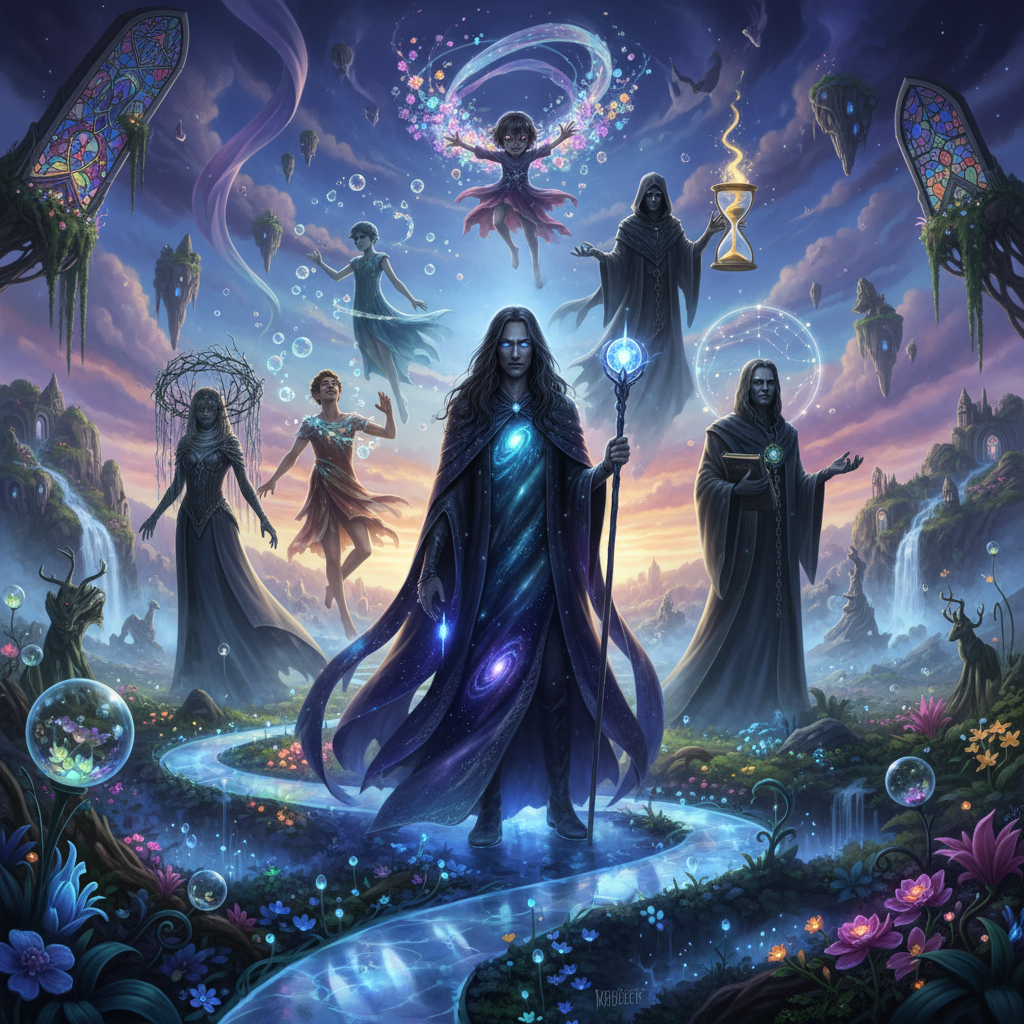
The first season of The Sandman ends with our protagonist winning the day, so to speak. He escapes from a group that held him captive in prison for 50 years, reclaims his talismans, finds the Corinthian and his family, then heads home to solve the Vortex crisis. Season 2 opens with Morpheus (Tom Sturridge) back in the Dreaming, mending the Dreaming, and dealing with a rare summons from one of his siblings. Morpheus is called together with Death (Kirby Howell-Baptiste), Desire (Mason Alexander Park), Despair (Donna Preston), and Delirium (Esmé Creed-Miles) to a parent-child intervention of sorts by the god Destiny (Adrian Lester).
Destiny confronts his older brother over the events of his recent family therapy session with Morpheus, and specifically over his decision to leave a subordinate in charge of Hell with no warning. This puts Morpheus on a collision course with his old flame and queen of the First People, Nada (Umulisa Gahiga), whom he sent to Hell for betraying him. This leads to another showdown between him and Lucifer (Gwendolyn Christie), who is still sore about being defeated in Season 1 and has taken to rather narcissistic behavior ever since. In the first season, Dream broke off a truce that Lucifer signed with her predecessor, and killed her, and Lucifer is still intent on getting revenge.
When he first tries to approach Lucifer, she easily dispatches his envoy, a skeletal terror he conjures to spook the demon. But later, Lucifer visits Dream when he’s off-guard, and rather than do battle with him, she resigns her post and leaves Dream with the key to an empty Hell and a host of candidates, ranging from Odin to Order, Chaos, and the demon Azazel. Lucifer isn’t ready to give up her powers just yet, but she’s also unwilling to govern her hell without any support, so she leaves Dream to choose his next champion for Hell.
Delirium makes it clear that she’s been missing their older brother, Destruction (Barry Sloane), who abandoned his realm and his siblings millennia ago, and their father’s comment on the subject leads Morpheus to his eventual, final destination—and his doom. Before his end, he spills familial blood in a way that the most notoriously fratricidal of the Endless, the brother who kills his sibling, Cain, can’t bring himself to, and finally earns the unbridled fury of the Kindly Ones, the Furies of his family.
Standout moments, missteps, and a death well-told
The high production value is maintained, as is the top-tier casting and gorgeous visuals that perfectly capture the magic of the source material’s artwork. The pacing, which some have taken to task for being on the slow side, is true to the source material and thus is unlikely to change.
As for the weak parts of the season, there’s only a handful of minutes that come close to qualifying in this regard. These are the scenes in the episode “Time and Night,” in which Dream visits his progenitors, Time (Rufus Sewell) and Night (Tanya Moodie), to ask for assistance in resolving his problems. The scenes are canonically not wrong—Time and Night really are the parents of the Endless, and in this timeline, they had their children much earlier in history than the more recent reality—but they are dialogue-heavy, with very little action or visual changes to break up the screenplay. The execution is the problem—the writing in these scenes, which Sewell’s performance can only do so much to elevate, comes off as stiff and awkward, and resembles a psychotherapy session rather than a mythological drama.