- calendar_today August 28, 2025
The Universal Themes Driving KPop Demon Hunters’ Popularity
In just two weeks after its June release, KPop Demon Hunters, an animated film about K-pop girl band Huntr/x taking on evil as guardians of humanity, has become Netflix’s number-one movie in 93 countries. The fantasy adventure scored more than 33 million views and is now in the second spot worldwide. Fans have already created fan art, and online demand for a sequel is increasing every day.
The success of KPop Demon Hunters is not limited to Netflix. In the two weeks since the movie was released on June 20, the two films’ fictional K-pop bands, righteous all-female Huntr/x and its naughty counterpart Saja Boys, have invaded the world’s real-life music charts. The seven songs from the film in the Billboard Hot 100 outperformed such K-pop giants as BTS and Blackpink. Spotify’s US chart lists two Saja Boys’ songs in first and second place. For a music group that does not exist in reality, that is unprecedented.
Mixing state-of-the-art K-pop hits with fantasy adventure and real-world K-pop culture, KPop Demon Hunters tells the story of three young female K-pop idols, Rumi, Mira, and Zoey (Huntr/x), and their double lives as global music stars and humanity’s secret defenders against paranormal evil. The band clashes with their “bandmates” Saja Boys in a big-screen extravaganza packed with epic stage shows, slick fight scenes, and a strong message about friendship, trust, and self-acceptance. Bridging the musical tastes and humour of teenagers with heart-pounding action and wholesome values, the film has been a cross-cultural hit among viewers from diverse backgrounds.
Visuals and story matter, but it is the music in KPop Demon Hunters that has resonated most strongly with fans. “As a Korean-Canadian director who has followed K-pop idols my whole life, I knew that music was key,” says Maggie Kang, one of the film’s directors. Music in KPop Demon Hunters is not just a source of entertainment for the characters: it is also a tool to fight darkness. Intertwined with the story, the songs of the fictional K-pop idols are there at the right moment,s and they add to the story rather than distract from it. “It gives the film a surprising level of maturity,” says Lashai Ben Salmi, a community leader and cultural bridge builder in Europe.
To achieve a quality on par with real K-pop hits, Kang and her co-director Chris Appelhans collaborated with a Korean label and a team of the K-pop industry’s top producers. Teddy Park, the Grammy-nominated hitmaker who has worked with Blackpink and others, and Grammy Award winner Lindgren, the producer behind BTS, TWICE, and many other K-pop hits, wrote original songs for the film.
The effect is entrancing. Amanda Golka, a Los Angeles-based content creator who is not particularly into K-pop, says she was hooked right away. “I have been blasting the soundtrack from Spotify every time I’m in the car,” she says. “It’s fascinating how music can be such a universal language.”
Authentic Korean Details
The film’s Korean cultural authenticity has also been a key to the movie’s success. K-pop music and other Korean cultural products like K-dramas and Korean films have already become mainstream in the US and other Western markets, but KPop Demon Hunters takes the representation of Korean culture a step further. In addition to traditional Korean fashion and hairstyles, the film is peppered with scenes of Korean daily life, such as having a meal with hands, taking hanuiwon herbs and warm foot baths at old Seoul neighbourhoods, and climbing to the top of Namsan Tower. “It is not limited to popular clichés,” Ben Salmi says. “The film provides the Korean viewers in the West with a rare moment of respectful and authentic representation.”
The production team’s research trip to South Korea was key in producing these authentic details. For visual references, the team visited folk villages, shot the streets of Myeongdong, and explored the details of traditional Korean garments and hairstyles. Korean is even in the animation: although the singers speak English in the final film, their lip-syncs move in a way that would fit Korean words better, and the acting is distinctly Korean. In some scenes, the filmmakers use Korean words and lyrics, and many Korean viewers have picked up on those hidden details.
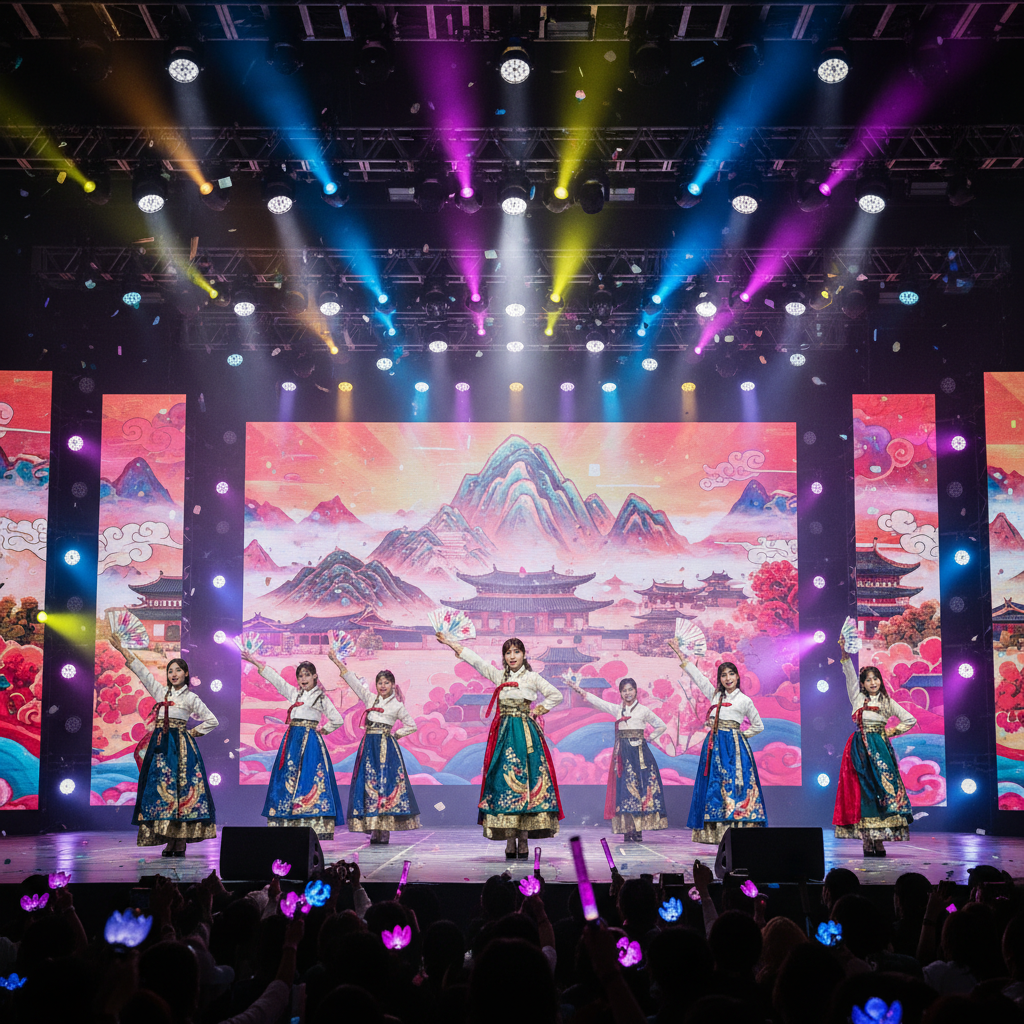
The same level of care can be found in the film’s depiction of fandom, including events like fan signing, light sticks, Kalgunmu (synchronised dancing in a group), Korean-language placards, and other details that felt very accurate to K-pop fans watching the film. At the same time, the film shows a wide range of K-pop culture, rather than focusing on a particular band or era. For viewers not that into K-pop, that makes the film easier to follow. At the same time, for K-pop fans, those references give a lot to spot and re-watch.
Fantasy Elements Tie in to Traditional Korean Culture as well. The weapons of Huntr/x, fans and swords, are symbolic of Mudang, Korean shamans, while the gangsta-look of Saja Boys evokes the Korean Grim Reaper. Symbols from Korean folklore, like Dangsan trees and Dokkaebi goblins, feature in many scenes. The two supporting characters, Derpy the tiger and Sussy the magpie, are traditional Korean mascots symbolising guardianship and bringing good luck.
At the heart of KPop Demon Hunters is a simple, relatable story about finding self-acceptance. The central characters struggle with their identity, learn to trust themselves, and embrace who they truly are. “Your friends may not understand right away, but they do love you and they will figure it out,” Golka says. “I think that has resonated with people.”