- calendar_today August 16, 2025
.
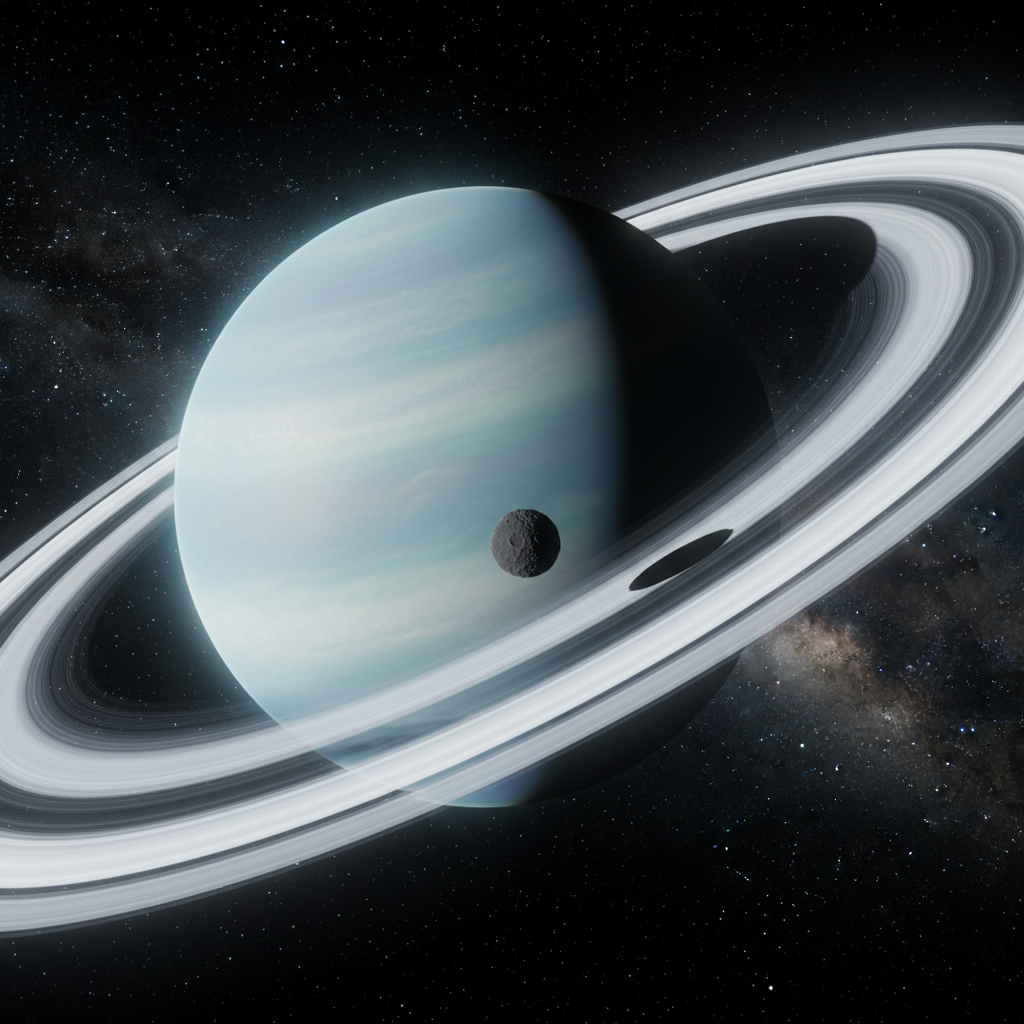
An anonymous Moon is the result of 29 moons orbiting Uranus, thanks to the James Webb Space Telescope. The finding of this recently discovered moon is not an isolated one.
Webb team members used long-exposure images of 40 minutes each to detect this small object, made visible on February 2 by using the Near-Infrared Camera onboard Webb. The new Uranus moon measures a meager 6 miles or 10 kilometers across and could be one of the smallest natural satellites ever discovered around the planet. It has remained hidden by other brighter objects like Uranus’s rings and previous spacecraft.
“We suspect there are even more small moons that we haven’t discovered yet. Voyager 2, the only spacecraft to visit Uranus, missed it,” said one of the new moon’s discoverers, Maryame El Moutamid, a lead scientist at Southwest Research Institute’s Solar System Science and Exploration Division in Boulder, Colorado. El Moutamid also noted that “it is a significant discovery even though this is a small moon.”
El Moutamid is one of the principal investigators of a Webb program studying Uranus’ rings and inner moons. She noted that this is evidence that Webb is building on past missions to push forward far beyond what we know.
S/2025 U1, as it is now known, is in a nearly circular orbit just over 35,000 miles (56,000 kilometers) from the planet’s center. It orbits in the planet’s equatorial plane between the two known moons, Ophelia (outside the main ring system) and Bianca, and was likely formed near its present location. The discovery was only made possible as the moon is extremely dark and as small and quick a target to observe from Earth.
Maryame El Moutamid, the lead author of the announcement research paper, and her colleagues used the Webb telescope to take multiple images with an exposure time of 40 minutes. As a result, the telescope can pick up any small infrared signal it may have missed before in visible-light images.
Webb has already taken in unique views of Uranus’ rings, weather, and atmosphere, so S/2025 U1 is building on the telescope’s early record.
“This is just the first of what will likely be many discoveries that Webb will help us make about Uranus’ ring and satellite system. What excites me is how quickly this came,” El Moutamid added. “We used data from the first observations made of Uranus only a few weeks ago.”
A Detailed Look at the S/2025 U1 Discovery
With Uranus now officially known to have five large satellites and 24 smaller ones, this new moon brings the number of Uranus moons to 29. The image is not showing every moon, as some are too faint to be seen. So far, scientists estimate that many more undiscovered moons still orbit the planet.
S/2025 U1 is small and moving quickly, making it challenging for astronomers to separate the light it reflects from Uranus’ bright disk and surrounding rings. In comparison, Webb’s ability to detect faint infrared light helped scientists to discover the moon. The moon joins the collection of inner moons of Uranus. But when was this recently discovered Uranus moon found?
In 1787, Uranus’ five major satellites, Miranda, Ariel, Umbriel, Titania, and Oberon, were the first to be found. Voyager 2 identified 10 more during its Uranus flyby in 1986. They have diameters between 16 and 96 miles (26 and 154 kilometers). Ground-based telescopes and the Hubble Space Telescope detected another 13 small moons, which are also among Uranus’ smallest satellites. They range from 8 to 10 miles (12 to 16 kilometers) across and are dark, likely darker than asphalt.
The inner moons are primarily ice and rock. In contrast, most of the Uranian satellites orbiting beyond Oberon are thought to be asteroids captured by the planet’s gravity.
A recently submitted planetary decadal survey by the National Academies of Sciences, Engineering, and Medicine in 2022 to NASA has recommended a Uranus Orbiter and Probe mission as the agency’s next large-scale project. The mission is expected to launch in the early 2030s but has an unclear future due to the lack of funding for its authorization among budget debates. The mission will investigate a series of exciting scientific questions, including Uranus’ tilted rotation, a swirling complex magnetic field, and atmospheric dynamics that underlie the planet’s meteorology.
Webb’s new detection could be a precursor to that mission, or we could discover more hidden satellites in the future. Additionally, the most interesting ones would be the moons around the outermost Uranian moons. They are potential icy ocean worlds that have remained unchanged for billions of years.
Scott Sheppard, an astronomer at the Carnegie Institution for Science, who was not part of the new study but co-discovered a Uranus moon in 2024, described the new find as “very exciting.” He stated that it is particularly close to Uranus’ inner ring system and, therefore, is a particularly notable find.
“Webb is very sensitive and allowed us to find this object. This is just one of what will likely be many discoveries that Webb will help us make about Uranus’ ring and satellite system,” El Moutamid said. The SETI Institute’s Matthew Tiscareno, co-principal investigator in the Webb Uranus project, said the detection is especially exciting because it muddies the line between the planet’s moons and its rings.
El Moutamid and Tiscareno’s team will continue to refine this new moon’s orbit and attempt to image more hidden satellites.
Discovering a new moon around Uranus also helps scientists understand better how its strange system formed. It also informs researchers more about its rings and prepares scientists for future missions like NASA’s Uranus Orbiter and Probe.