- calendar_today August 31, 2025
FX/Hulu’s Alien: Earth Brings Noah Hawley’s Vision to Life
FX and Hulu’s forthcoming prequel series Alien: Earth has been so long in development that it feels like a new series is being released every year. As the August 12, 2025, premiere date rapidly approaches, the streaming networks have dropped a final trailer (and more complete synopsis) for the show they say will be both chilling and contemplative. The latest glimpse at Alien: Earth combines its ruminative, almost existentialist interludes with bursts of frenzied science fiction body horror, including glimpses of a mysterious, shadowy alien ship drifting silently through outer space; bloodless corpses strewn across darkened corridors; humans covered in gore scrambling to escape; and, in the far distance, a nearly-familiar form: A xenomorph skulking in the shadows.
Expectations are high for the series, given Hawley’s track record for pacing, coupled with the promise of his commitment to tightly weave the show’s rich mythology through its complex cast and intricate narrative arcs. Hawley has suggested the tone and mythology of Alien: Earth will be more closely in keeping with the moody mythos of Ridley Scott’s original Alien (1979) than with the following prequels, Prometheus (2012) and Alien: Covenant.
Set in 2120, Alien: Earth’s eight-episode run takes place in a near-future world that is just beginning to feel the choking embrace of corporate supremacy; a world in which society’s most powerful companies will go to nearly any lengths to stake their claim over humanity’s most prized possession: life itself. For these companies, and the people who serve them, the future is the ultimate prize, a tantalizing promise of immortality.
A Future World Governed by Corporations & Corporations Only
In Alien: Earth, Earth in 2120 is not governed by countries or politicians. Instead, five megacorporations, Prodigy, Weyland-Yutani, Lynch, Dynamic, and Threshold rule with their interests in mind. And this is the era of the Corporate Era. An era in which the lines between human and machine are already beginning to blur. Cyborgs—humans whose bodies have been artificially enhanced by machine parts—mix with synthetics, humanoid robots powered by artificial intelligence. But this delicate balance of synthetic and organic is about to be upended by the pioneering work of the young, prodigiously talented Founder and CEO of the Prodigy Corporation. As the world’s most powerful and wealthy corporations jockey to one-up each other in the promise of a profitable future, Prodigy’s scientific advances have created a new kind of humanoid: hybrids, synthetic robots injected with actual human consciousness.
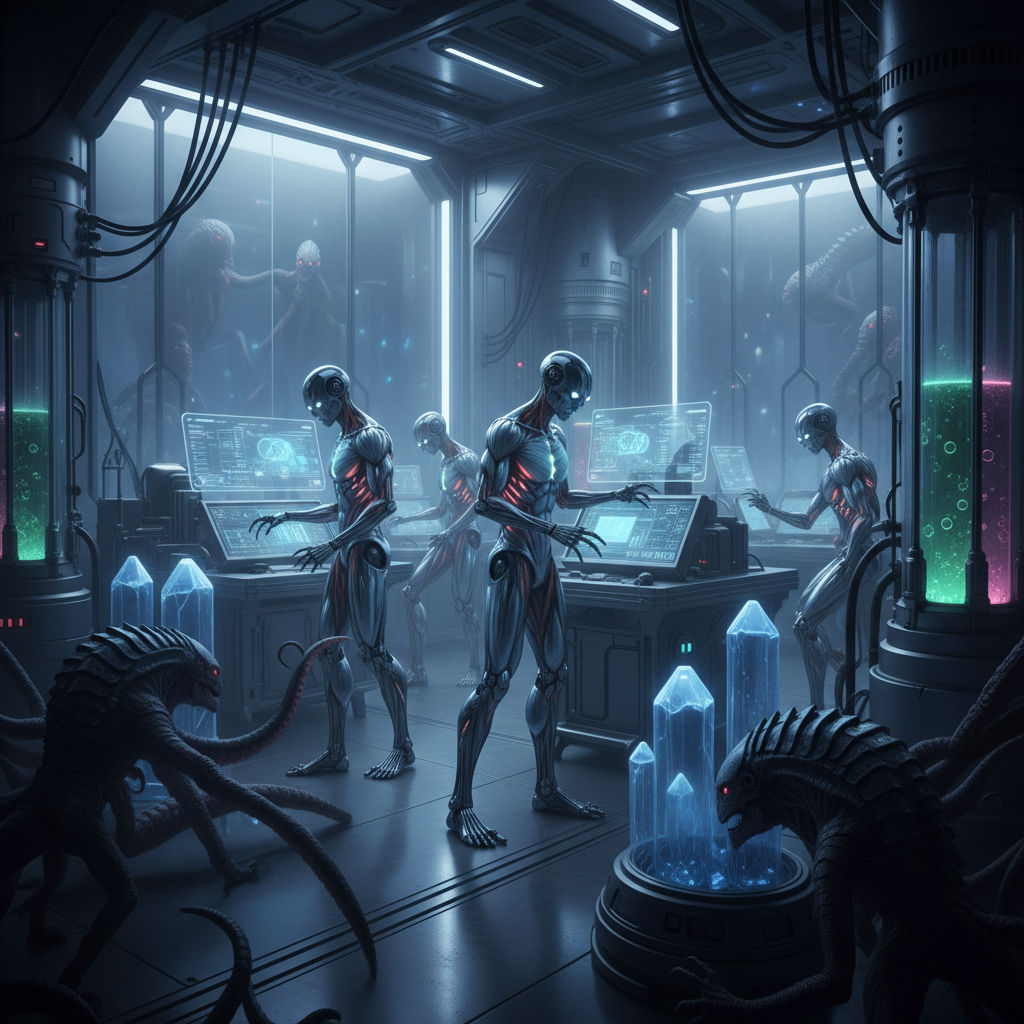
The first of these hybrids is “Wendy,” an adolescent-like being who will play a central role in the events to come. Played by Sydney Chandler, Wendy is described as a “humanoid robot with the body of an adult and the consciousness of a child.” In the official synopsis: “Set in 2120, Alien: Earth follows Wendy, a female human-machine hybrid who was designed as part of a scientist’s plan to live forever. When a foreign spaceship crash-lands near the facility, Wendy bravely volunteers to venture out and retrieve its mysterious cargo. But instead of a scientific breakthrough, she finds a ghastly massacre. Locked inside are five alien life forms — deadly, unknown species that, in true Alien fashion, are brought back to a laboratory for analysis. It’s a fatal set-up that pits human greed against the deadliest threat in the universe.”
This uneasy calm is shattered by the impact of a Weyland-Yutani spaceship crash landing right in the middle of Prodigy City. In the wake of this disaster, Wendy and a group of other hybrids come into contact with several unknown organisms from outer space — creatures far more deadly and insidious than any threat to which humanity has ever been exposed. From this collision of corporate ambition, scientific ethics, and alien body horror springs a new series of terror to stalk the imagination.
Completing Alien: Earth’s large ensemble cast are Timothy Olyphant as Kirsh, Wendy’s synthetic mentor and trainer; Alex Lawther as soldier CJ; Samuel Blenkin as Boy Kavalier, a calculating CEO; Essie Davis as Dame Silvia; Adarsh Gourav as Slightly; Kit Young as Tootles; David Rysdahl as Arthur; Babou Ceesay as Morrow; Jonathan Ajayi as Smee; Erana James as Curly; Lily Newmark as Nibs; Diem Camille as Siberian; and Adrian Edmondson as Atom Eins.
The Road From Teaser to Series Reveal
FX and Hulu have taken a surgical approach to building anticipation for Alien: Earth. In January, they dropped the shocking surprise short teaser at Super Bowl LIV’s AFC Championship game. Shot entirely in the first-person perspective of a xenomorph (yes, an actual xenomorph), it followed the creature sprinting down a spaceship corridor as the ship plummets towards Earth at rocket-like speed. The brief, intense first-person clip featured no dialogue and no context. In the two years since, questions have grown into theories, and now fans are finally getting some real answers.
The first full trailer for the series dropped last month. Opening with footage of Wendy’s creation in 2120 on a research island called Neverland, the trailer picks up when a foreign alien spaceship crash-lands near the facility. Wendy, as we learn later in the trailer, volunteered to go out and retrieve the strange cargo. What she found was not a scientific treasure trove, but grisly carnage. Inside the decimated ship were five alien life forms—deadly, alien species humanity has never before encountered. In true Alien fashion, they’re soon reanimated and brought back to a laboratory for study.
It’s an ominous prelude any Alien fan can read like the dictionary: human hubris colliding head-on with an apex predator. As the final trailer more clearly indicates, Alien: Earth is not so much about blockbuster action sequences but rather about sowing paranoia, both for how the inevitable conflict will unfold, and also in what ways corporate greed and human ambition, inevitably, prepare the way for apocalypse.