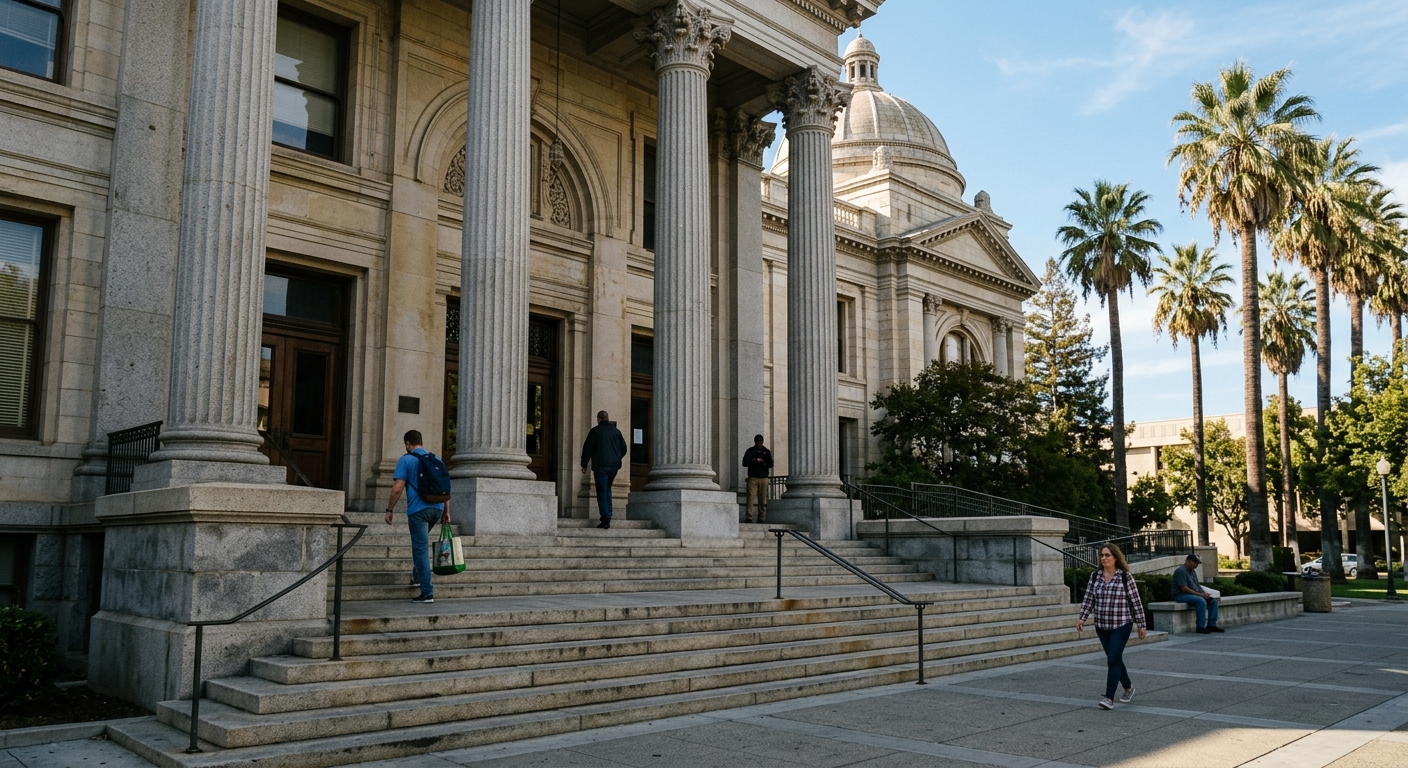
AI-generated illustration; not a photograph of the reported event.
- calendar_today October 15, 2026
California’s 100th Lawsuit Targets Courthouse Immigration Arrests
California has reached a milestone in its legal opposition to the Trump administration, filing its 100th lawsuit in less than two years. The latest suit, announced on October 15, 2026, by State Attorney General Rob Bonta, challenges the practice of U.S. Immigration and Customs Enforcement (ICE) agents arresting individuals for alleged civil immigration violations at or near state courthouses.
Concerns Over Impact on Justice and Constitutional Rights
Bonta argues that courthouse arrests for immigration enforcement disrupt the rule of law and threaten the constitutional rights of victims, witnesses, defendants, and other parties to court proceedings. He stated, “We’ve seen serious criminal charges dropped and entire cases jeopardized because victims and witnesses are too scared to come to the courthouse to testify. Our justice system cannot function this way.”
This latest suit marks what Bonta called a “sobering milestone” for his office, which he says reflects persistent legal challenges to what he characterizes as Trump’s disregard for constitutional boundaries rather than political interference from the state.
Pattern of Legal Challenges Between States and Federal Government
The rise in lawsuits is part of a broader trend, with state attorneys general increasingly using the courts to challenge presidential policies. During Trump’s first term, California filed more than 120 lawsuits against the administration. In parallel, Texas filed just over 100 lawsuits against the Biden administration under Attorney General Ken Paxton. Experts such as Daniel Farber of UC Berkeley Law School argue that the Trump administration’s aggressive policy rollouts and focus on California have intensified these legal confrontations.
ICE Enforcement Practices and State Pushback
ICE has defended its strategy of making immigration arrests near courthouses as “common sense,” citing the ability to apprehend offenders at scheduled appearances. However, incidents in California, such as arrests outside courthouses in Los Angeles, Rancho Cucamonga, and Riverside, have raised alarm among attorneys and advocates. Alejandro Barraza, a criminal defense and immigration attorney, described clients altering legal strategies or pleading guilty due to fear of ICE enforcement at or near court facilities.
An ICE memo from May 2025 authorized agents to make arrests at courthouses based on credible information about targeted individuals’ locations. This resulted in a spike in such enforcement actions, prompting concerns about the broader consequences for due process and courtroom participation.
Court Rulings and Legislative Responses
Efforts to limit ICE courthouse arrests have met mixed results. In June 2026, U.S. District Judge P. Casey Pitts in San Francisco issued a nationwide ruling striking down ICE’s expanded courthouse arrest policy, restoring previous restrictions except in limited circumstances. The Trump administration has appealed the decision. Meanwhile, California lawmakers passed legislation, signed by Governor Gavin Newsom, to strengthen protections against civil arrests for people traveling to or from courthouses. The law establishes a 1,000-foot protection zone around court facilities, with exceptions for judicial warrants.
Bonta contends that a lawsuit against the federal government remains necessary despite the new state law, stating that the administration sometimes disregards state measures and courts have occasionally sided with federal authority—such as a recent appellate ruling blocking a state law requiring federal agents to display identification.
Ongoing Legal and Political Battle
California’s legal actions against federal immigration enforcement and other Trump administration policies have secured wins on issues like birthright citizenship, federal funding, and deployment of federal resources. Legal scholars, including Michael McConnell of Stanford Law School, have called some lawsuits meritorious due to what they characterize as federal overreach. However, others question the use of state resources for ideological litigation when private litigants could also challenge federal actions.
Looking ahead, Bonta emphasized that California will continue to challenge the Trump administration if it pursues policies the state considers unlawful or damaging. He concluded, “It was a shock and awe. It was flood the zone. It was trying to overwhelm with speed and volume, and we kept pace every time.”
Source: latimes.com.
Recent Posts

Hot Categories

132
Business

70
Events

172
News

81
Sports
103
Technology