
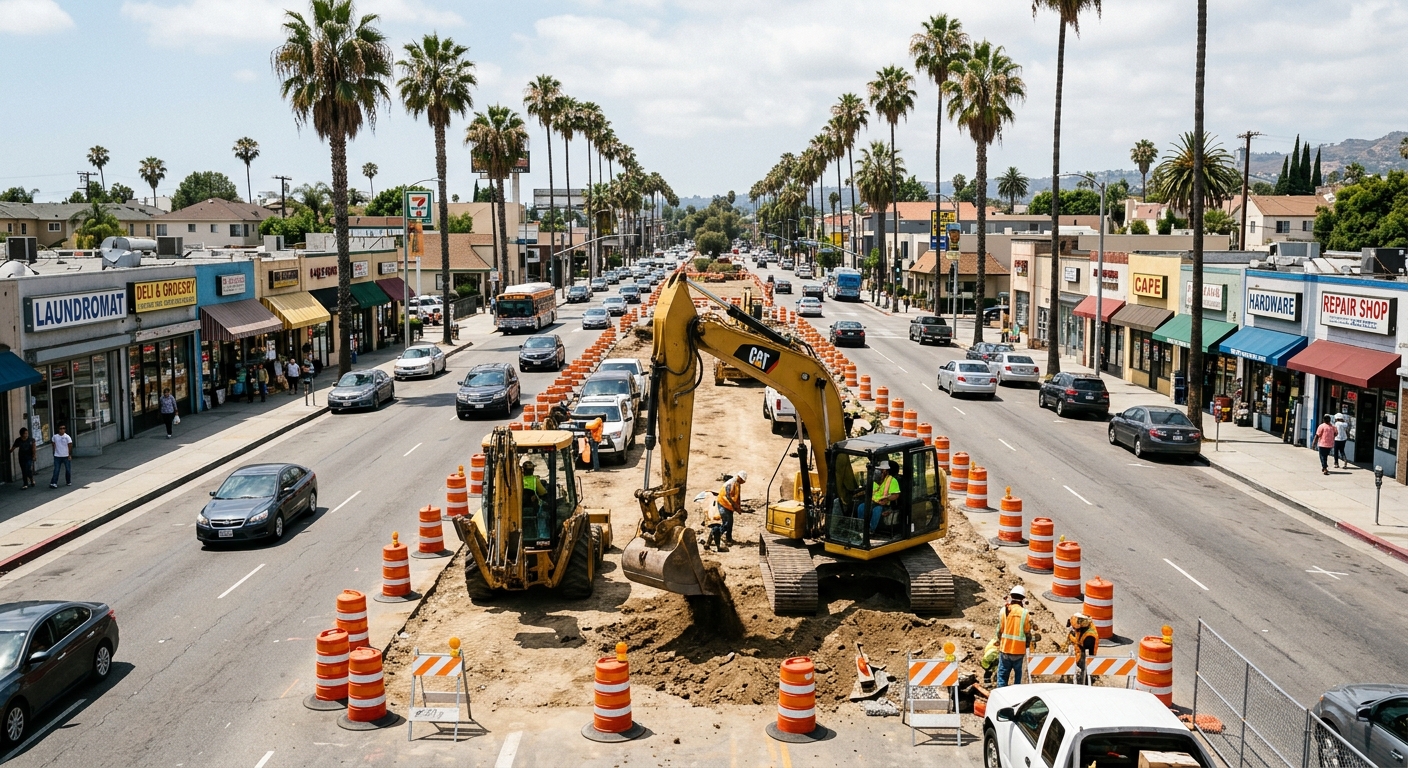
AI-generated illustration; not a photograph of the reported event.
- calendar_today October 20, 2026
Major Light Rail Project Underway in the San Fernando Valley
Construction has officially begun this week on the East San Fernando Valley light rail project, a development marking the return of commuter rail service to the region for the first time in over 70 years. The new 6.7-mile line, running from Van Nuys to Pacoima, is projected to open in 2032 according to the Los Angeles County Metropolitan Transportation Authority (L.A. Metro).
Long Delays and Rising Costs
The light rail line, set to cost nearly $4 billion, has experienced significant delays and budget overruns. Approved in 2018 with an initial estimated cost of $1.3 billion, construction was originally expected to begin in 2021 and finish by 2027. The project is now beginning five years behind schedule, and its cost has more than tripled. The delay was acknowledged during Monday’s groundbreaking event, though Metro officials did not provide a specific explanation for it. The Metro board had approved a budget increase in May to account for higher construction costs.
Route, Stations, and Public Transit Expansion
The East San Fernando Valley light rail line will travel along Van Nuys Boulevard and include 11 street-level stations. When opened, it will connect commuters to other major transit services, including Metro’s G Line and the Van Nuys Metrolink-Amtrak station. In the future, the line is expected to link to the Sepulveda Transit Corridor train, further integrating the region’s public transit network. Currently, only two bus lines serve the area targeted by the project, which saw nearly 20,000 boardings in September, according to Metro data.
Funding Sources and Community Support
Funding for the rail line comes from a mix of local and federal sources, including Measures R and M—two local sales tax initiatives earmarked for transit—and an $893-million federal grant. Local leaders have emphasized the importance of such transportation funding in expanding and modernizing public transit options in the heavily traveled, transit-dependent communities of the San Fernando Valley.
Commitment to Transit Equity and Local Businesses
Officials promoting the project have highlighted its potential to advance transit equity. Los Angeles City Councilmember Adrin Nazarian described the light rail as a “long-overdue … economic justice” for the overlooked immigrant communities lacking robust public transit. “This is about equity, about inclusivity, about making sure that we’re making the investments that make it easier for people not to rely on costly forms of transportation,” said Nazarian at the groundbreaking event.
L.A. County Supervisor Lindsey Horvath, who represents the Valley and serves as a Metro board member, also emphasized the area’s reliance on public transit since the loss of Pacific Electric streetcars in 1952. Community discussions around the project have been ongoing since 2010.
Minimizing Construction Impacts
While the project will bring long-term benefits, construction will temporarily remove some parking along Van Nuys Boulevard and affect local traffic. Metro has provided grants to multiple small businesses affected by the construction, and State Assemblymember Celeste Rodriguez stated efforts are underway to keep neighborhoods and business owners informed and supported. Rodriguez underscored the importance of a successful transit project encompassing safe sidewalks, shaded waiting areas, reliable transit connections, adequate parking, and clean, well-lit stations for all residents.
Looking Ahead
Once completed, the East San Fernando Valley light rail will serve as a key link in the region’s expanding transit network, enhancing connections and mobility options for San Fernando Valley residents and workers. The light rail construction signals a major step forward in public transit expansion for this transit-dependent area.
Source: latimes.com.
Recent Posts

Hot Categories

132
Business

70
Events

172
News

81
Sports

103
Technology
