
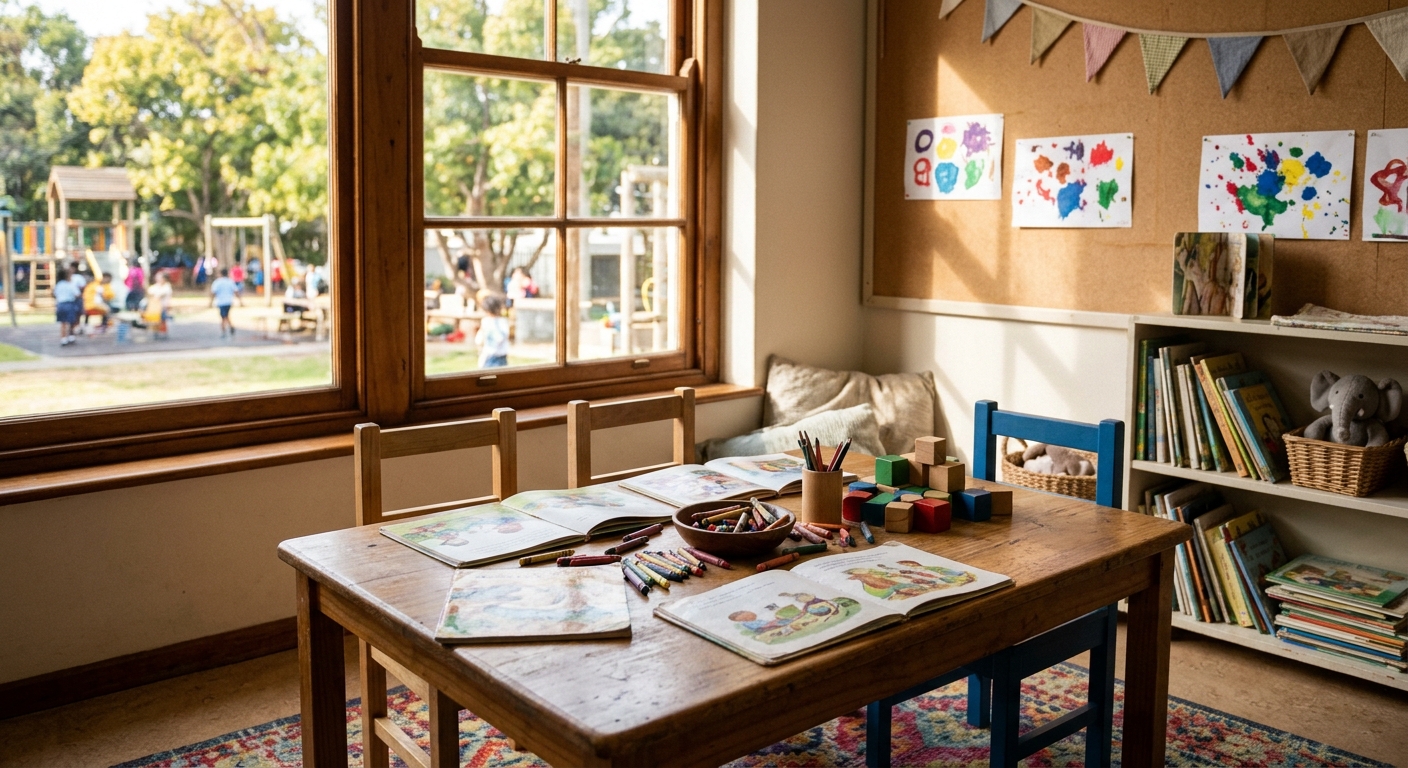
AI-generated illustration; not a photograph of the reported event.
- calendar_today October 22, 2026
Comprehensive Study Reveals Lasting Impacts of Transitional Kindergarten
One of the most expansive analyses of California's investment in early education has determined that children who participated in transitional kindergarten (TK) and preschool programs achieve significant academic advantages years later. The findings, released on October 21, 2026, underscore the importance of early education initiatives, especially for low-income children, as California broadens access to free transitional kindergarten for all 4-year-olds.
Major Academic Gains Documented
According to UC Berkeley researchers commissioned by Stanford University, children who enrolled in the state's original transitional kindergarten, established by law in 2010 and implemented in 2012, were 11 months ahead in reading and eight months ahead in math by third and fourth grades. These results were compared with children born in similar months who did not have access to the program. The expansion of state-funded preschool alongside the introduction of TK has allowed more children to enroll by age three, magnifying these academic gains.
Benefits for Low-Income and Dual-Language Learners
The study highlights especially strong results for children from low-income backgrounds. Among children with English-speaking parents, those from low-income families who attended transitional kindergarten alone gained about seven additional months of learning in third-grade reading and math. Even more dramatic benefits were observed among children from low-income families whose parents spoke a language other than English and who attended both preschool and TK—these students saw fourth-grade math gains roughly five times and reading gains three times greater than their peers who did not attend state-funded preschool. The results indicate that early intervention programs can significantly help close persistent academic achievement gaps related to income and home language.
Classroom Observations Confirm Findings
Teachers report practical differences in readiness and academic skills for children who participated in transitional kindergarten. For instance, Marylou Escobar, a kindergarten teacher in Glendale with four decades of experience, notes that her students with TK backgrounds demonstrate stronger classroom skills from the outset. They are better prepared for structured learning, can follow instructions, and have already acquired important classroom behaviors and fine motor skills, all of which set a foundation for acquiring more advanced literacy and math abilities.
Challenges and Next Steps for Early Education
Despite these positive findings, California faces ongoing challenges as it works to expand transitional kindergarten and maintain educational quality, particularly by recruiting and training enough qualified teachers. Rucker Johnson, UC Berkeley professor and study co-author, emphasizes the need for a robust and adequately prepared teacher workforce to meet the demands of the new grade level. Further research is anticipated to track whether early academic progress translates into higher graduation rates and improved college readiness in the long term.
Broader Implications for Educational Equity
Experts agree that while early education is not a guaranteed solution to all academic disparities, it provides a crucial opportunity to foster educational equity and enhance school readiness. Anna Markowitz, an associate professor at UCLA, remarked that even modest learning gains are noteworthy in this field, and the study serves as proof that high-quality early education, including transitional kindergarten and preschool programs, can create meaningful and lasting benefits.
Source: latimes.com.
Recent Posts

Hot Categories

132
Business

70
Events

172
News

81
Sports
103
Technology
