
- calendar_today August 20, 2025
.
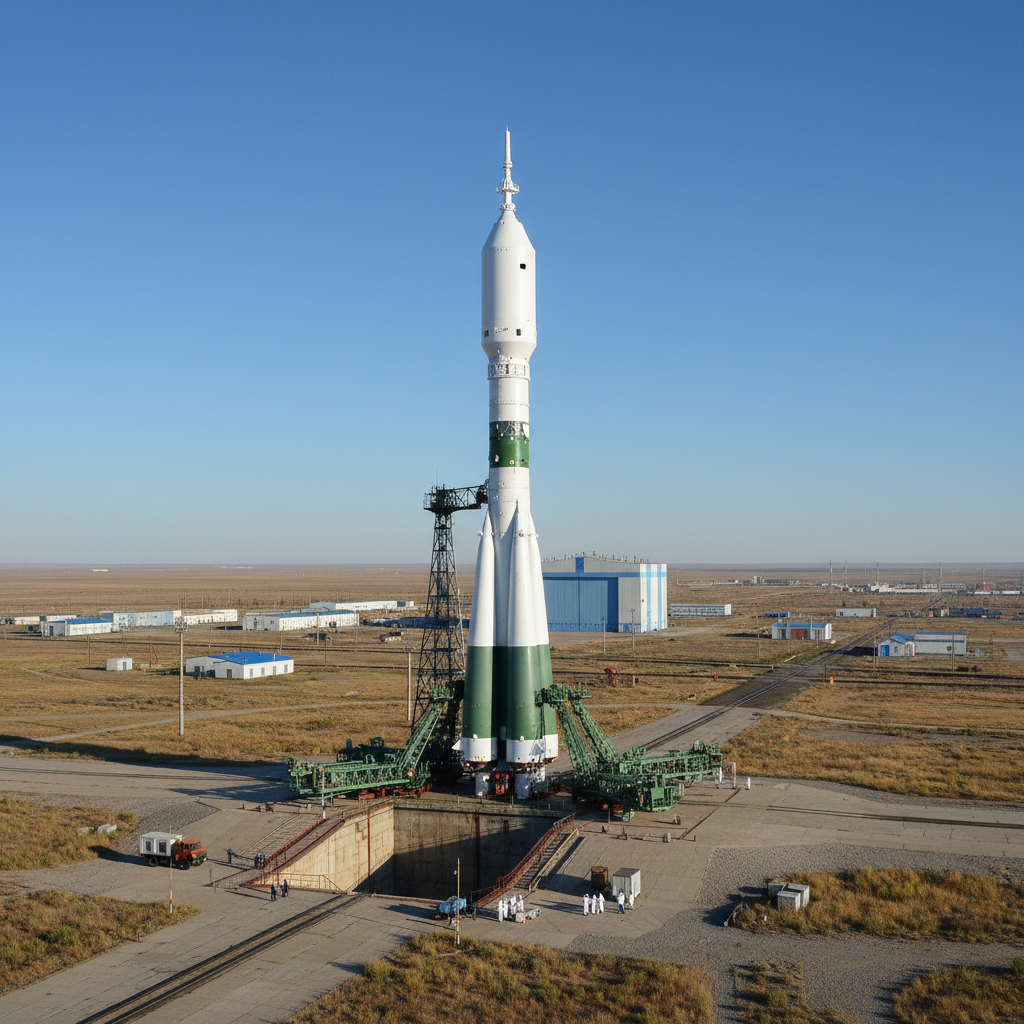
Russia is expected to conduct the maiden flight of its latest rocket Soyuz-5 rocket before the end of 2023. Roscosmos Head Dmitry Bakanov told Russian state news agency TASS that final preparations for the vehicle’s first liftoff are in the “final stage” with December expected as the date for flight.
Soyuz-5 is currently set to fly from the Baikonur Cosmodrome in Kazakhstan. A successful liftoff will mark the inaugural mission for a rocket that was in development for over a decade. Roscosmos plans to conduct a series of test flights with the rocket before it enters regular service, but that milestone is not expected until 2028.
Building on Soviet Heritage
Soyuz-5, also known by the name Irtysh, is not a radical departure from previous designs. Instead, the rocket is closely based on the Zenit-2 rocket designed in the 1980s by the Yuzhnoye Design Bureau in Ukraine.
Zenit rockets were manufactured in Ukraine but powered by Russia’s RD-171 engines. While the system required some cross-border cooperation, Zenit was one of the few truly international aerospace programs in the post-Soviet space. That arrangement changed after Russia invaded Ukraine in 2022 and continued into the following year with a reported missile strike on the Ukrainian facility that assembled Zenit rockets.
The Soyuz-5 is, in essence, an enlarged and Russian-built version of the Zenit. The redesign itself removes the reliance on Ukraine, as all critical components are built domestically. In that regard, the shift represents a win for Moscow, who was able to break free of a dependency on Ukrainian parts while also phasing out the long-serving Proton-M launcher.
Technical Legacy
Soyuz-5, from a technical perspective, is a medium-lift rocket. It can deliver some 17 metric tons to low-Earth orbit, an improvement made possible by enlarging the rocket’s propellant tanks when compared to Zenit. At the core of the Soyuz-5 is the RD-171MV engine, the latest in a long line of engines with a storied past.
The engine is a descendent of the propulsion system used by the Energia rocket of the 1980s, which powered the Soviet Union’s one-and-only space shuttle, Buran. The RD-171MV differs from earlier variants in one crucial aspect: it is completely free of Ukrainian components.
Fuelled by kerosene and liquid oxygen, the engine is capable of producing more than three times the thrust of the NASA Space Shuttle main engine, earning it a distinction as the most powerful liquid-fuelled rocket engine currently in operation.
In that regard, however, the Soyuz-5 itself is an expendable rocket. In stark contrast, newer competitors such as SpaceX’s Falcon 9 were designed with reusability as a primary design feature. That divide has proven detrimental in international markets and leaves some doubt about Soyuz-5’s commercial prospects.
That being said, Soyuz-5 serves an important purpose for Roscosmos as a domestic workhorse. But while Russian industry is fully capable of building Soyuz-5, development of a next-generation rocket is in a very different place. And with limited funding due to the war and international sanctions, building a new reusable rocket from scratch has proven difficult.
Roscosmos has the Amur rocket, also called Soyuz-7, in development. Amur is billed as the “successor” to Soyuz and as such features a reusable first stage along with methane-fueled rocket engines. In terms of cost, such a system could eventually be competitive with SpaceX’s Falcon 9. But technical challenges have delayed its maiden flight to 2030 or later.
That leaves Soyuz-5 as a stopgap between the current generation and the next. It is a workhorse that can ensure Russia’s space program has a means to conduct orbital launches even if the technology dates back to Soviet times.
Roscosmos, of course, would like to be more competitive internationally. The commercial market for orbital launches, however, has been transformed since the last Soyuz 5 counterpart first flew in 1999, with SpaceX and Chinese providers now setting the price for the entire sector. Russia has continued to offer its Soyuz-2 rockets for crewed launches as well as the Angara rocket family for heavier payloads, but neither has carved out a sustainable niche internationally. If Soyuz-5 can do better, only time will tell.
Nonetheless, Roscosmos has put itself in a position to launch Soyuz-5 despite the sanctions and limited funding. A successful launch in December will put that on display and show that Russia, at least, is still able to place new rockets on the pad and launch them into orbit.
Recent Posts

Hot Categories

135
Business
71
Events

172
News

81
Sports
106
Technology

