
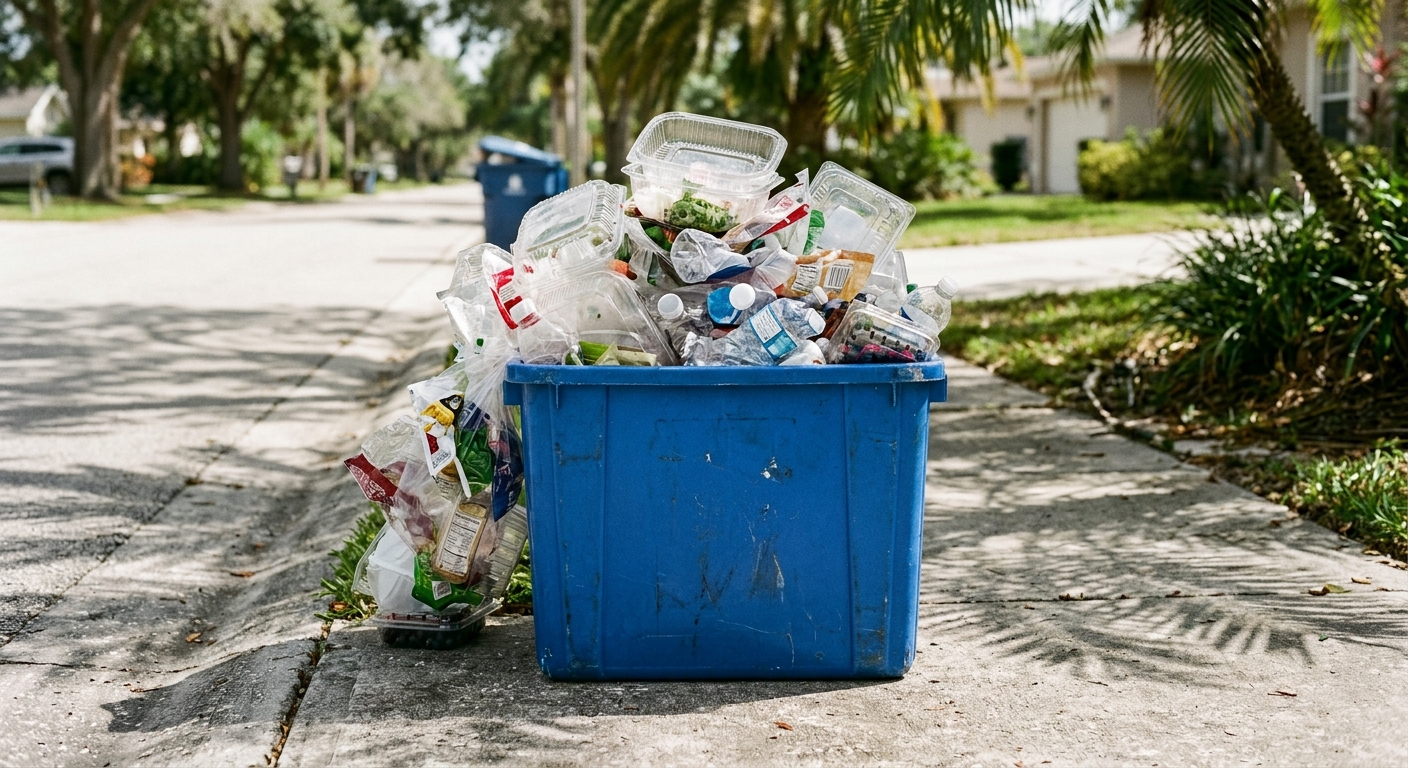
AI-generated illustration; not a photograph of the reported event.
- calendar_today November 18, 2026
California's Plastic Producers Under Scrutiny for Reporting Lapses
California's ambitious efforts to limit plastic pollution have encountered a major challenge, as a recent report from the state's waste agency, CalRecycle, reveals that only about half of companies involved in making and distributing plastic packaging have reported required data. This shortfall puts the effectiveness of the state's single-use plastic law in question and raises broader concerns about industry compliance.
The Importance of Accurate Baseline Reporting
The state's significant single-use plastic law, Senate Bill 54, mandates that by 2032, plastic producers, packagers, and distributors reduce new single-use plastic use by 25%. Critical to meeting that goal is establishing a baseline—the total amount of single-use plastic sold and distributed in California during 2023. This baseline serves as a reference point for future reductions and for measuring compliance with the law.
In 2024, CalRecycle initially estimated the baseline at 2.9 million tons. However, on November 2, the agency adopted a substantially lower baseline of 1.03 million tons, a figure provided by industry producers. This change, while not explicitly required by the law or its implementing regulations, means that the eventual plastic reduction will be based on a much smaller initial figure.
Industry Compliance and Data Issues
According to CalRecycle director Zoe Heller, not all data provided by reporting producers was complete or accurate. The agency discovered instances of partial accounting, inaccuracies, and reporting errors. As a result, some data had to be excluded from the final baseline calculation.
State Sen. Catherine Blakespear expressed concern over the widespread lack of reporting, describing the trend as "very concerning." She cited ambitions to allow businesses to find cost-effective ways to become more sustainable, but warned, "We're choking on plastic... And so when big business is not reporting, it's very concerning."
Impacts on Plastic Reduction Targets
The change in baseline numbers has significant implications. If the state had retained its original 2.9 million ton estimate, roughly 725,000 tons of single-use plastic would be removed from commerce by 2032—about 37 pounds per Californian annually. Using the lower industry-submitted baseline, only 250,000 tons (13 pounds per person) would be eliminated, meaning a substantially smaller environmental impact.
Under the law, the Circular Action Alliance—a state-approved industry group—oversees the plan to achieve reduction targets, sets fees for companies, and funds recycling programs. CalRecycle is responsible for approving the plan and enforcing compliance. The law was intended as a compromise with environmentalists who agreed to withdraw a stricter ballot measure in favor of this industry-preferred regulatory approach.
Addressing Misreporting and Enforcement Challenges
Heller confirmed that CalRecycle will refine the baseline annually as more accurate and complete data is received. Producers that continue to misreport or fail to submit data could face penalties. However, the issue of "free riders"—companies that avoid fees and paperwork while their competitors comply—remains a concern. Studies of similar systems in Europe found that the percentage of such non-compliant companies can range from 1% to 30%.
Sen. Blakespear advocates for stronger enforcement: "I would like there to be more enforcement, and I would like CalRecycle to act with a stronger hammer. How do you shift incentives around packaging design if companies don’t think they need to participate?"
Outlook for California's Plastic Reduction Efforts
While some industry representatives argue that reporting lower numbers could ultimately lead to stricter future cutbacks, enforcement and participation rates will play a key role in determining the law's success. CalRecycle plans to update the baseline as reporting improves, but lingering gaps in compliance could undermine the intended trajectory towards a significant reduction in single-use plastics in California.
Related coverage
Source: latimes.com.
Recent Posts

Hot Categories

155
Business

74
Events

220
News

83
Sports

120
Technology

