
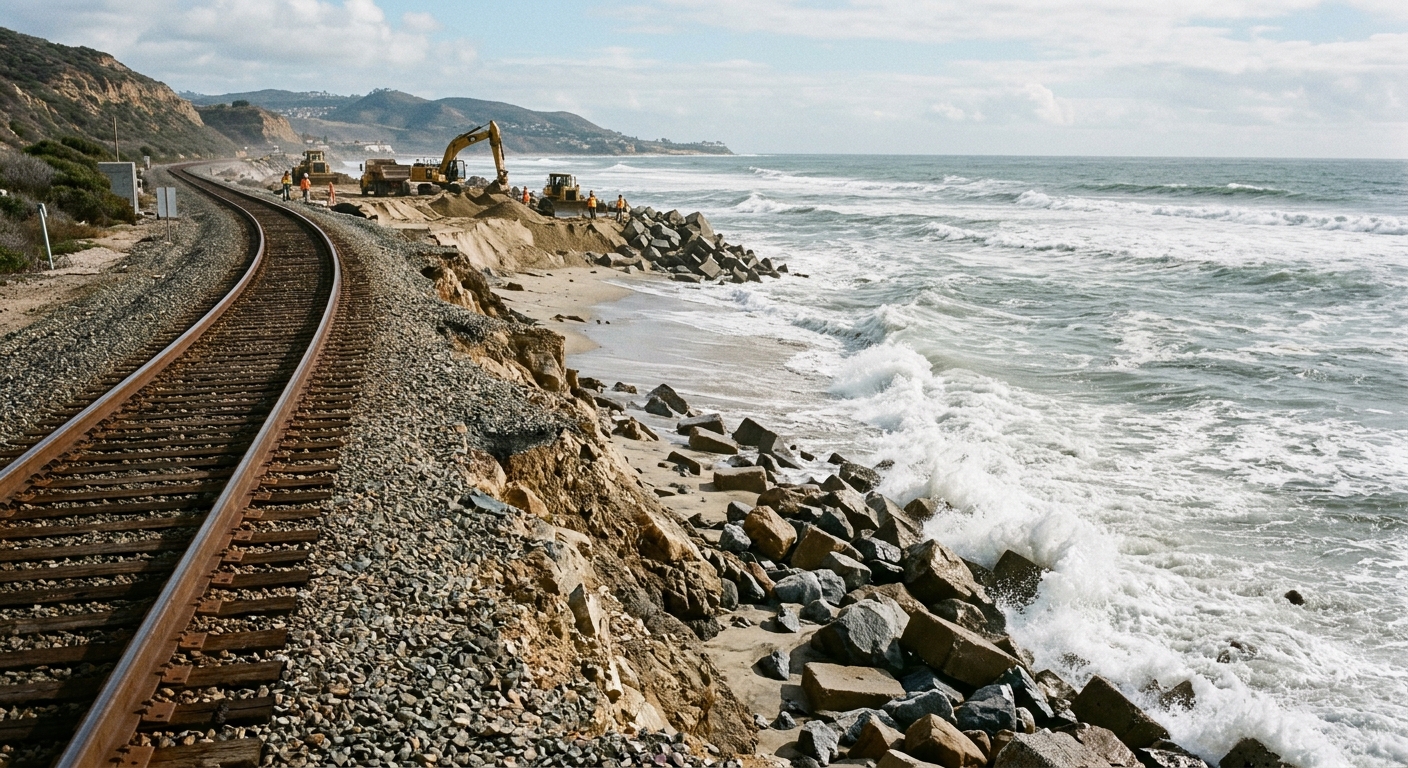
AI-generated illustration; not a photograph of the reported event.
- calendar_today November 6, 2026
California Coastal Commission Approves Major Shoreline Project
The California Coastal Commission has given the green light to a large-scale sand replenishment project intended to fortify the endangered railway line running along San Clemente’s coastline. The project, which aims to address rapid coastal erosion and protect the area’s shrinking beaches, comes after years of severe storms and rising sea levels have repeatedly closed the essential transportation corridor.
A Response to Years of Beach Erosion and Rail Closures
Recent years have seen the San Clemente rail line battered by harsh waves, strong storms, and rising seas, all culminating in frequent closures. According to the Orange County Transportation Authority (OCTA), the railway has been cumulatively closed for a total of 12 months since 2021 due to erosion and bluff failures. The California Coastal Commission processed 15 stabilization projects during this period, with 10 classified as emergency permits.
In October 2026 alone, the railway was partially shut down due to high tides, following a temporary closure in September owing to erosion after a strong Pacific storm. Earlier in the summer, heavy waves and erosion had also forced the line to close for several days.
Details of the Sand Replenishment Initiative
The newly approved permit allows for the placement of nearly 700,000 cubic yards of sand along targeted sections of San Clemente’s coastline. This action represents the largest sand replenishment effort in over 60 years for this stretch of coast, according to local officials. The work is funded by $300 million in state and federal resources earmarked for the protection of the most threatened four miles of coastline, with about a third of this amount allocated specifically for the sand replenishment project, potentially slated to begin as soon as January.
"This is the first step to resolving a half century of inaction by our community," said Orange County Supervisor Katrina Foley, a member of the OCTA board of directors, at the Coastal Commission hearing. Foley emphasized the importance of sand on the beaches as a buffer to protect the rail line, contrasting it with previous measures such as seawalls and rock piles, which have sometimes exacerbated erosion issues.
Balancing Shoreline Protection and Public Access
The 10-year coastal development permit issued by the Commission balances emergency rail protection measures with long-term goals for coastal preservation and public beach access. It includes plans for constructing a 1,200-foot seawall, as well as conditions for maintaining and removing large rock piles (riprap) and “tiebacks” placed along nearby bluffs. These structures were installed during prior emergencies to stabilize the railway after damage from storms and erosion.
As part of the permit, railway owners and operators are required to monitor the effectiveness of the new sand placement and assess its durability within five years. Furthermore, the permit mandates studying the long-term future of the line, including potential relocation options for the consistently threatened railway.
Concerns from Environmental Advocates and Community Members
Despite the joint efforts of the Coastal Commission staff and OCTA, the agreement has drawn criticism from local environmental groups, surfers, tribal leaders, and residents. Organizations such as the Surfrider Foundation, Orange County Coastkeeper, Save Our Beaches San Clemente, and the California Coastal Protection Network voiced concerns that the measures do not go far enough, urging the Commission to require the maintenance of a 50-foot sandy beach seaward of the railway.
Commission staff acknowledged the proposal but stated that such a benchmark is too stringent for immediate adoption, pending further observation of how the initial sand replenishment performs. Kate Huckelbridge, executive director of the Commission, underscored the urgency of the situation, particularly in the context of the current El Niño climate event, but emphasized the need for immediate action while continuing to monitor and develop future requirements.
Looking Ahead: Long-Term Solutions for Rail and Coastline
The San Clemente rail line, operational since 1888, has always been exposed to coastal hazards due to its proximity to the ocean. Its scenic location is a major draw for travelers, but in recent years it has become especially vulnerable to the impacts of sea level rise and climate change. With the new sand project, state agencies and local officials hope to buy time and gather data to inform more permanent, sustainable solutions for the protection of both the railway and California’s famous coastline.
Source: latimes.com.
Recent Posts

Hot Categories

142
Business

71
Events
186
News

81
Sports

109
Technology

